email Youtube

Home
Galleries
Blog
Workshops & Calendar
Store
Resources
About
Contact

Strawberry Jam recipe

July 8th, 2007

Hi all! I’ve been asked for my jam recipe. Glad to oblige! I do a hot-water-bath canning, following the instructions in the Ball Blue Book, which is the home canners “bible.” You can get a lot of canning supplies at www.homecanning.com, and I heartily recommend the Blue Book (which I even saw at Wal-Mart the other day!). The Basics kit at that website is a good one…. an outlay at first, but SO worth it to get the jar-grabbers, blue book, proper canning pot, etc., all at once.

I prefer Pomona’s Universal Pectin, which is usually found in health and natural food stores. I like it because you can use either honey or lower amounts of sugar, so that you taste the berries, not just “sweet.” In the box you get two packets, one of pectin and one of powdered calcium. Using their instructions, you make “calcium water” (1/2 tsp. of calcium powder per half cup of water).

Mash / chop 4 cups of berries. Place in heavy pan (I used our second-hand Le Creuset enameled iron pot on low to medium heat); add 2 tsp. calcium water and heat to boiling.

Most pectins require an equal amount of sugar, so 4 cups sugar for 4 cups berries…erg. Pomona’s has you use 3/4 to 2 cups for 4 cups of berries depending on sweetness. I used about 1 1/4 cups per recipe since the berries were nice and ripe. Measure sugar into bowl and stir in 2 tsps. pectin.

When fruit reaches boiling, stir in sugar/pectin mix. If, after mixing, it is still a little tart, add a bit more sugar. Allow to reach boiling again.

Meanwhile, have lids and rings in a saucepan of simmering water to sterilize, and boil your canning jars (do NOT re-use commercial jars–they are single-use only and can shatter if re-heated again!) also to sterilize. Just before the jam comes to a boil the second time, remove the jars from the hot water bath to ready for filling.

I set the jam pan on a hotpad next to the jars (which are set on a rack), and use a wide-mouth funnel to fill the jars to 1/4″ from the top. The proper amount of headspace is important for avoiding bacterial contamination and getting a proper vacuum seal. If the strawberry jam is foamy on top, which it usually is, take a dollop of butter on a fork and swirl it around the top to cut the foam (which looks icky but is actually OK to consume). Ladle into jars. If need be, clean drips from the top edge of the glass jar and place new lid on top, then screw down sealing ring. (You can’t re-use a lid…must have virgin rubber ring on it to get a proper seal).

Place jars in hot water bath for about 20 minutes after the water returns to a boil. The fruit in the jam will rise to the top of the jars…when you open a jar up, just stir and mix it back up.

Allow jars to cool, then remove the rings! If jam has oozed out, wipe clean. Make sure the lid “pops” and “sucks down” to make a vacuum seal (so as not to poison yourself with spoiled jam!). If the lid doesn’t seal, remove the lid, try a new one and hot-water bath again (I only had this happen once in 47 jars), or just pop that one in the fridge to use first.

That’s it!

For other jams, you can get fancy. Blueberries need an acidifier, so instead of lemon juice, try lime…yum! And the Ball Blue Book recipe for Plum jam in the “fancy jams” is heavenly. I made Shiro plum (yellow plums) with zest from Clementines and Mandarine Napoleon liqueur once…definitely not for PB&Js….. great on fresh biscuits!

Thanks for asking! In about two weeks, maybe raspberry jam!
If it is early July, it’s Strawberry season in Maine

July 7th, 2007

Yep…. long time readers will remember this from last year. It is jam-making time! I loved the comment last year when someone told me they almost licked their screen! Berries1

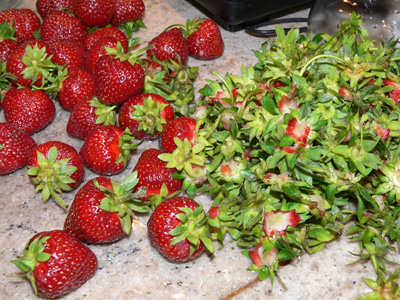
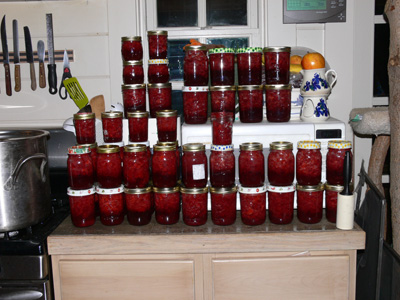
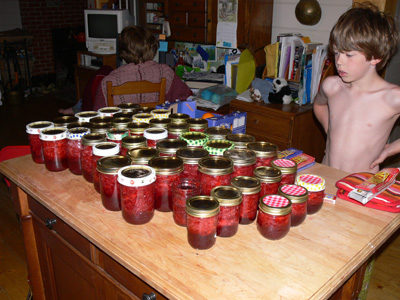
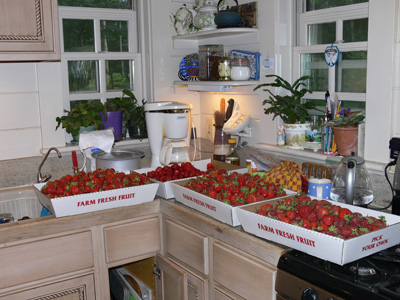
Here is what 45 pounds of strawberries looks like (above). The past two years we have picked our own, but (big surprise!) Paul and I picked 30 of the 38 pounds, while the two boys picked 8 pounds and fussed. Well, Paul’s rotator cuff is torn (surgery in 2 weeks, and not soon enough he ways) so he can’t pick, and he agreed it was unreasonable to expect me to pick that much. Plus, we RAN OUT of 38 pounds worth of jam. OK, 38 pounds minus munchies during creation….. So thanks to Mr. Bellmore at Spears U-pick farm, he set aside four flats for me (the cost is a little more than U-pick…and I think it is worth it!!!!). They were ready Monday. Monday evening I hulled and washed the berries (for hours):Berries2 hulling berries

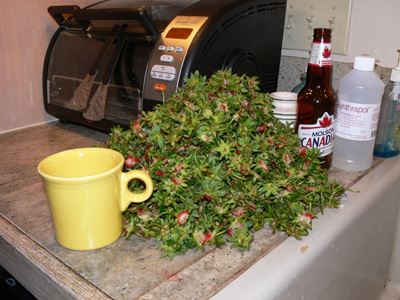
This is what 42 pounds of strawberry hulls looks like:Berries3

Then on Tuesday I made jam until I ran out of pectin (we bought more on the way to the Sea Dogs game in Portland). Then I sliced the remaining berries, minus a colander’s worth of really good, ripe ones with stems left on.Berries5

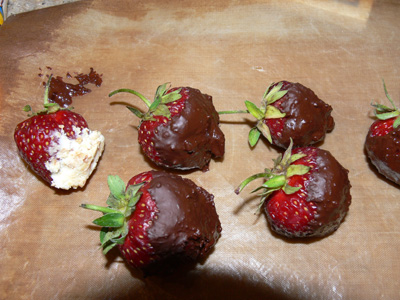
Eli, smart lad that he is, remembered when I had made chocolate dipped berries in Friday Harbor (at least 4 years ago…when he was 5!) and suggested we do it again. So we did. Alas, I let the chocolate get too hot, so they weren’t as pretty as they could be, but who cares…they tasted good! Melting the white chocolate chips was not successful, tho.

Chocolate covered berries

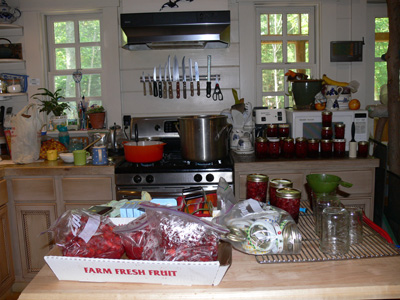
On Wednesday, I spent the entire day making up the rest of the jam. I use Pomona’s brand Universal Pectin, which is designed to use low sugar or honey. For 40+ pounds of berries, I used less than 15 pounds of sugar! That means my jam tastes like BERRIES, not sugar! The boys love it, and I love that they love it. We ended up with 42 pints, in mostly pint jars (until they ran out when I used half-pint jars, which the boys can vacuum up in a day!!!!!) There are 8 pint jars hidden in this picture, to the left of the microwave and behind the first row….
Berries6

And to justify all the work, had to add one more photo of Eli surveying a year’s worth of jam: Then I had to box ’em all up and haul them down to storage in the basement. May splurge and (for the first time in 4 years) make raspberry jam later, too! Gonna let Mr. Bellmore pick them, too (well, his farm hands!).Eli surveys the bounty

And as an aside…totally cool: Mr. Bellmore rents his farm, for 25+ years, from the Spears family, which has owned the land since 1735 (down in Warren on Route 1, a mile up from the intersection with Route 90). When I asked about the heavenly-scented tree between the house and the farm stand, turns out it was a gift from the US Ambassador to Japan to the family…. in 1865! It isn’t supposed to grow this far north. It is now taller than the 2 story house, and Bellmore has a picture of it beside the house from the late 1800s when it was a bit taller than a man! Way cool! If I get back down there for the raspberries before I head to California, I’ll take a picture of the tree. Mr. Bellmore said he has tried to grow seedlings and cuttings, but they always get killed off, yet the big tree thrives.

Happy 4th of July

July 5th, 2007

Close up of major bursts fireworks

as usual… a bit late and behind the curve…what else is new?

Fireworks..outfieldWell, for our fourth, we celebrated a tad early by going to a Sea Dogs (minor league baseball in Portland, Maine) game on July 3rd because…as my clever hubby figured out…they were having fireworks! And, the weather was actually a lot better on the 3rd than on the 4th.Fireworks..outfield 2

I took my camera, and to my amazement tried the “night scenery” setting without a tripod and (after taking nearly 100 shots and deleting over half) ended up with some decent shots and one or two good ones, and some goofs that were actually pretty cool! Imagine what it would be like if I had taken a tripod (I was too tired, rushed and so on this year, but for sure I’ll do that next year!).

Doesn’t this one look like a neon sculpture?

webp1060606.jpg And I liked this one too:webp1060602.jpg

The Frayed Edges Grid

July 4th, 2007

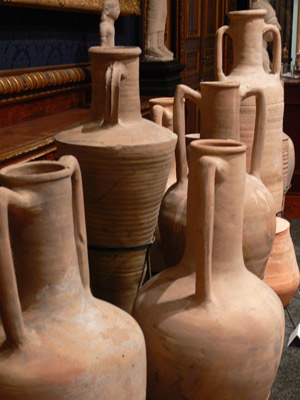
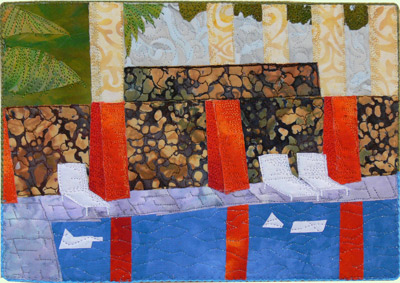
I mentioned in an earlier post about our mini-group, the Frayed Edges, that we are having a group show in the Picker Room at the Camden Public Library (there is month-long show each month ranging from vintage lithographs and etchings to contemporary oils to art photography and more). We wanted to do a single group project, but one that our hectic lives would be able to absorb. We each contributed a photo, and each of us made a small project based on the five photos. I offered a photo I took last summer at the Ringling Museum, in Sarasota:

amphoraephoto400.jpg

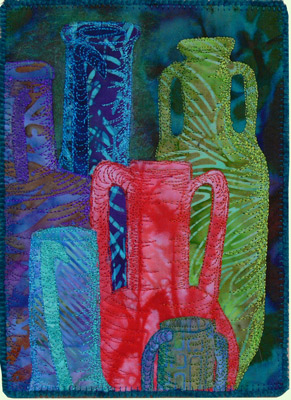
This photo and one Kathy took, of a brilliant orange beach umbrella, sand, sea and sky, are the two 5″ wide by 7″ tall pieces. The other three photos are also 7 inches tall, but 10 inches wide. That way when we hang them, each row will be of five 10″-tall pieces. So, here are mine, starting with mineAmphorae:

And here is the one I did from the photo Deborah contributed (photo was taken by her husband Jeff in Central America):Deborah400

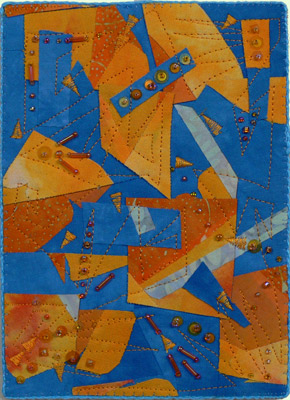
Then I tried an abstract (actually, I did this one first, but love the way it turned out!). I fused up Kathy’s umbrella, then sliced it up into pieces and put it back together:

Kathy’s Umbrella, Abstracted

Hannah’s Flower was a challenge, so I think I’ll save that one for my next post, and show the first attempt, how I saved the first effort, and my second much more successful effort at the 7×10 size. That leaves Kate’s St. Michael’s church in Kiev. Kate’s daughter is adopted from the Ukraine, and she took these photos on the adoption trip. The domes and colors are spectacular in the original photo. All of us honed in on the domes immediately, but in very different ways. I decided to try my hand at foiling with beads:Kate’s St. Mike’s, Kiev, Ukraine


The cost of doing business

July 1st, 2007

I found the link to a fascinating post on Joanie San Chirico’s blog, which sent me to Edward Winkleman’s blog. Who you might ask? Honestly, I’m not sure, but it is a fascinating breakdown on the expenses faced by an art gallery. As he and Joanie rightly noted, many people (emerging artists included) are surprised that a gallery’s cut is 50 percent of the sales price, and only 50 percent (60 if you’re lucky, like me! living in not-really-rural Camden) to the artist. Why? well, Winkelman’s explanation is worth reading: click here to open it up in a new window.

When I worked for an interior designer on San Juan Island, Wash. (that was a whole ‘nother set of nightmares, but I learned a TON about high-end home dec sewing, interior design, and business), the designer used to quote the adage that “the cost of doing business is one-third.” That apparently applies across a lot of industries. As well, wholesale in many industries, including quilting, is fifty percent of suggested retail.

So, despite our math-phobias, let’s do the math. If you take a yard of fabric at $10 per yard, you can guesstimate that the wholesale cost was $5 per yard plus shipping/freight/delivery charges. The cost of doing business is 1/3, or $3.33 (one third of $10), which covers rent, utilities, insurance, wages, cash register receipt paper, fees charged by credit card companies, and so on. Then, if like Maine-ly Sewing, the shop is nice and gives you a ten percent discount because you are a member of a guild, that is another dollar.

If you’ve been doing the arithmetic, that is 5 + 3.33 + 1 = 9.33. That leaves all of 67 cents of “profit” for the shopowner. No wonder quilt shop owners and other shop owners work so hard and have such a long road to staying in business.

For me, I’m thrilled to have my sales at Ducktrap Bay Trading Co., a gallery here in Camden, Maine. I may not make a lot (close to minimum wage) when a journal quilt sells, but it SELLS. Which it would not do otherwise (like sitting in storage on my spare bed). The owner and staff work hard (without being pushy or intrusive) to sell all the works (last time I was in a new staff member wanted to ask me about my work and inspiration so he would have more to tell customers!), and pay their bills, so they deserve their cut, too.

And I won’t grump about the price of things in stores as much……especially not quilt stores!