email Youtube

Home
Galleries
Blog
Workshops & Calendar
Store
Resources
About
Contact

Welsh Quilts, Part 3 of 3

February 6th, 2012

The two most recent additions to my small collection of books on Welsh Quilts came from the Jen Jones Welsh Quilt Centre.  Jen Jones, by the way, is an expat American who moved to Wales, married and has made her life there.  The first is A Towy Guide (according to the acknowledgements, the idea is/was a series of guides covering various aspects of Welsh heritage) called Welsh Quilts by Jen Jones.
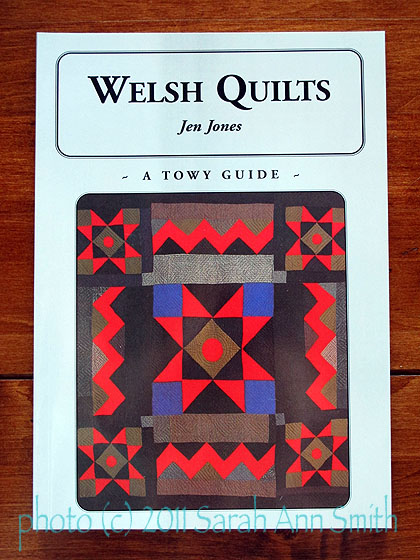
Jen Jones' 1997 book on Welsh Quilts

Sixty-six pages and about 7×9 inches, this small book has a LOT of great information.  I just checked Amazon.com, but the price is a ridiculous $68 (US) and up, and you can get it for a reasonable price even with postage from the UK and a foreign transaction fee!  The chapters include:

  • Introduction
  • History
  • Making a Quilt
  • Method
  • Types of Quilts
  • Joining and Finishing
  • Provenance
  • Buying a Welsh Quilt
  • Caring for Quilts
  • Conclusion
  • Blankets
  • Types of Blankets
  • Public Collections of Quilts and Blankets
  • Bibliography

As an aside, I’ll note that Wales also has a wonderful weaving tradition, and for EONS I carried a Welsh tapestry (woolen cloth) coin purse that I think I bought in the UK in 1978; I recently found the little mousie made of the same cloth, and he’s now sitting on the small table on our stair landing.  Photos in the Towy Guide are both color and some black and white, but in all cases the detail of the stitching is wonderful, as is seeing the old implements used.  Antique quilts in the photos date back as far back as 1830.

The second book, Welsh Quilting Pattern and Design Handbook by Marjorie Horton,  is one that covers what I had most  hoped to find:  information about the most typical motifs and designs of the quilting.
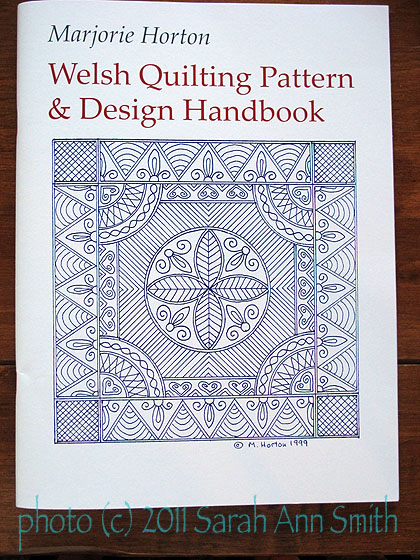
Marjorie Horton's book on design for Welsh quilts

To my utter surprise, when I opened it up, Marjorie Horton lives in Rainier, Washington!   I googled her and found several mentions, and it appears she is still active in the Pacific Northwest and  giving lectures and teaching, but could not find a website or blog for her.   Although there is an Amazon listing, it says the book is currently unavailable.  Not quite–I bought mine a month ago, albeit from Wales.
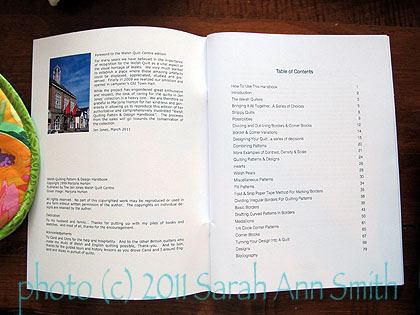
Table of Contents and inside cover

This book, at least the incarnation that I have, is published by the Jen Jones Welsh Quilt Centre.  From what I’ve been able to gather, the book was originally self-published with a comb/spiral type binding.  All black and white, the illustrations are hand-drawn, which I find refreshing after all the slick graphics you see.  I love seeing the designs in Marjorie’s hand!  There is a TON of good information about designing your own, special things to note (like parallel lines to define segments), and a lot of visual imagery for various widely used motifs.
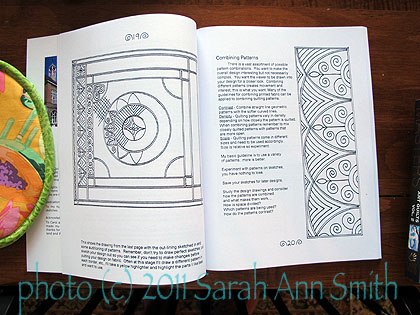
Sample pages from Welsh Quilting Pattern and Design Handbook

If you want to design your own Welsh-inspired quilt, as I do,this book is JUST what you need.  Now I realize that this may be a niche of a niche within a niche of a small corner of quilting, but oh what a find!  And if you love the quilting and traditional Amish-style quilting, I’m guessing you will find LOTS of inspiration in this book.

So I guess I might be well advised to read these books carefully, take notes, and start sketching, eh?  And oh yeah…dye that fabric so I have a 105 x 105 inch (about 3 metres to a side) top to quilt…EEEK!   On a sit down machine?  Am I nuts?  Clearly the answer is yes.  A hazelnut, please.
True to Life, 4

February 3rd, 2012

Another subject that is dear to my heart is storytelling, both in words/literature and in pictures/art.  Hockney touches on this in True to Life:  Twenty-Five Years of Conversations with David Hockney, by Lawrence Weschler, p. 47 (also from Cameraworks chapter, 1983).

“recently I’ve been trying to figure out ways of telling stories in which the viewer can set his own pace, moving forward and back, in and out, at his own discretion.”

Later, on p. 50, Hockney continues:

“I mean, the urge to depict and the longing to see depictions is very strong and very deep within us.  It’s a five-thousand-year-old longing —- you see it all the way back to the cave paintings, this need to render the real world.  We don’t create the world.  It’s God’s world, he made it.  We depict it, we try to understand it.  And a longing like that doesn’t just disappear in one generation. Art is about correspondences—-making connections with the world and to each other.  It’s about love in that sense–that is the origin of the erotic quality of art.  We love to study images of the world, and especially images of people, our fellow creatures.  And the problem with abstraction, finally, is that it goes too far inwards and the links become tenuous, or dissolve, and it becomes too hard to make those connections.  You end up getting these claims by some of the formalist critics that art just isn’t for everybody—-but that’s ridiculous.

  “The revival of the figure with many of the young painters today testifies to the enduring longing for depiction, although the crude character of much of this s o-called neo-expressionist drawing testifies to the deterioration in basic  training which we’ve seen during the last couple generations.  I mean, training people to draw is basically training them to look.”

WOOOO HOOOOO HOOOO!   YES!  we can all be trained to LOOK by training ourselves to draw! I’ve been saying that for some years now–so nice to see it confirmed by someone like Hockney!  Folks in the 19th century, before the advent of the camera and/or before photography became widespread, could draw passably.  No, not everyone was brilliant, but this is a skill that CAN be learned!  (and a plug for a great book…The New Drawing on the Right Side of the Brain by Betty Edwards... I’ve done that through self study and hopefully will get back to going through it for a second time…yes, you can even teach yourself!)

And I love how Hockney doesn’t pussyfoot around—I too just don’t get the appeal of non-representational  art.  It just leaves me wondering “OK, what’s next?”  I know some folks love it, are inspired and create that way.  But I just don’t get it.  I like the story, the connection to someone.  Think about it…what would National Geographic be like without the photos?

Fog and Snow

February 1st, 2012

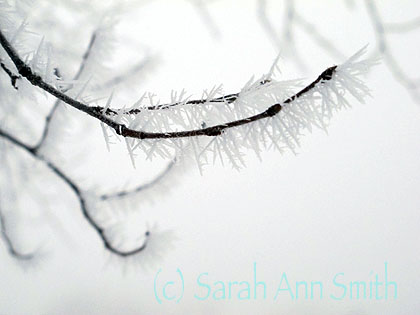
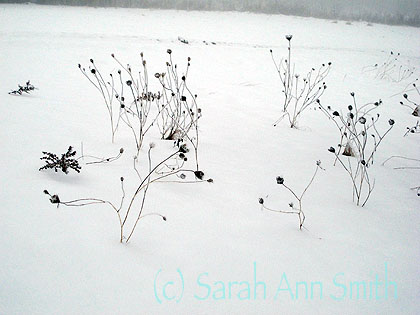
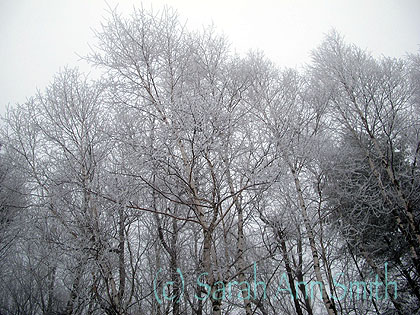
At long last we got a light dusting of snow yesterday—it has been a balmy, mild winter here in the far northeast corner of the US.  Until yesterday afternoon (January 31st for heaven’s sake!) we could see bare ground in way too many places.  Better today…. though I am mystified how it can be 95 percent humidity when it is 23 degrees F (below freezing for those of you on C. scale).  But, that meant we woke up to this:

I love it when the branches are all white.....

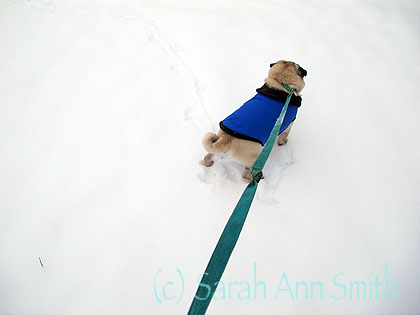
So this morning when I went out to do this,

Mom! STOP taking pictures, I wanna GO! I smell critters!

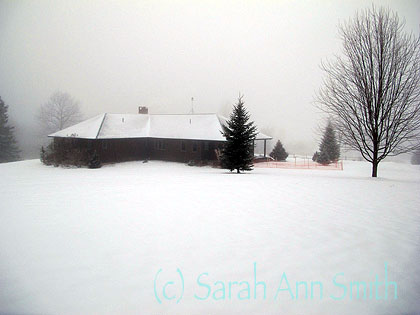
I took the camera!  Since the snow barely covers the ground and walking is easy, I went up behind the house and took this shot:

From behind the house, the view obscured by white fog

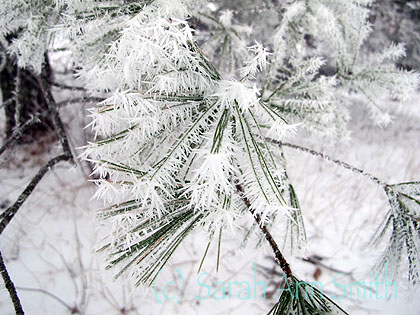
By this time last year we had about 18 inches, not two, of snow!  But I love how sometimes crystals grow on the branches and dried grasses:

Isn't that just spectacular, those shards of gentle ice?

And the pine grew the crystals too

And I’m still obsessed with milkweed pods and Queen Anne’s lace… this shot could so easily be turned into a great graphic design for fabric:

Queen Anne's Lace stalks that didn't get mowed before winter set in

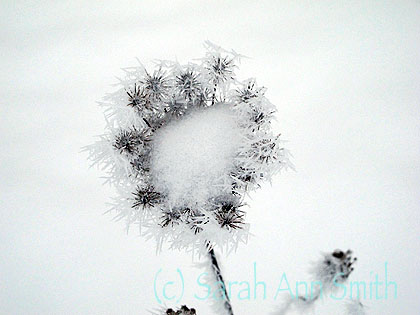
I may have to go try this photo again…. it is a bit hard to see the ice crystals against the background of snow, but I love the crystals and how the dried flower pot makes a cup or nest of snow:

A nest of snow

Here’s to hoping we get at least one good blizzard this winter.  I love staying home, snug and warm, reading and (if the power doesn’t go out) quilting!   Now, to get down to the studio.  Nope, breakfast first, THEN studio!

Welsh and English Quilts, Part 2 of 3

January 30th, 2012

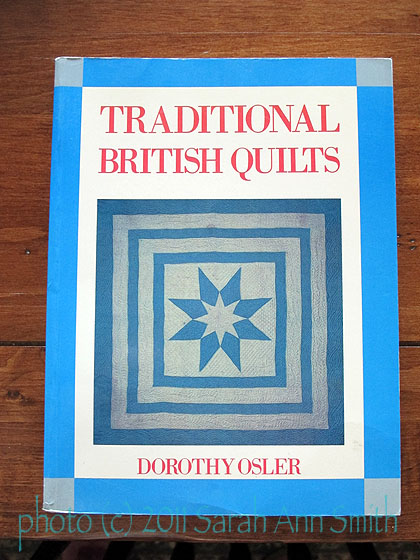
OK…so I amended the title a little!   The next two books are one that I have had a long time and one which I sought for a long time and focus entirely or mostly on English quilting!  Let’s start with the latter:  Traditional British Quilts by Dorothy Osler.  Most of the time over the years  I looked for this book, the price listed was well over $100!  Too steep for my wallet.  Finally, I found it at Amazon at a tolerable price for Used, anywhere currently from $18 to $32 (US dollars).

A definitive reference book

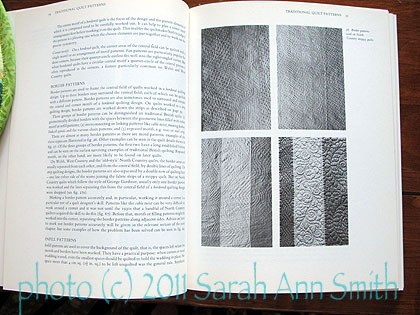
This book is cited as a reference in just about any subsequent book you find on British and Welsh quilting, and I can see why.   At 168 pages, with black and white photography (it was printed in 1987–what a long way publishing quality and images have come in just a couple decades!), it is very well researched with ample footnotes and citations.  If you are looking for a hands-on how-to book using today’s methods with lots of projects, this is NOT the book for you.  If, however, you enjoy the history of quilts with lots of photos of how things used to be done, with very crisp black and white photos that show remarkable detail, then you’ll be quite happy with this book.

Detail photos of quilting in North Country Strippy quilts

The major sections include  (remember, this is about traditional quilts, not using rotary cutters and templates!)

Part One:  Making Traditional Quilts:

  • Materials and Equipment
  • Traditional Quilt Design
  • Traditional Quilt Patterns
  • Making a Quilt

Part Two:  Traditional Quilts:  A social and Cultural History

  • Historical Background  (going back to before 1200 AD)
  • Social and Regional Influences
  • English Quilts (North Country, West Country and Rest of England)
  • Welsh Quilts
  • Scottish Quilts

And the usual resources, index, and footnotes.

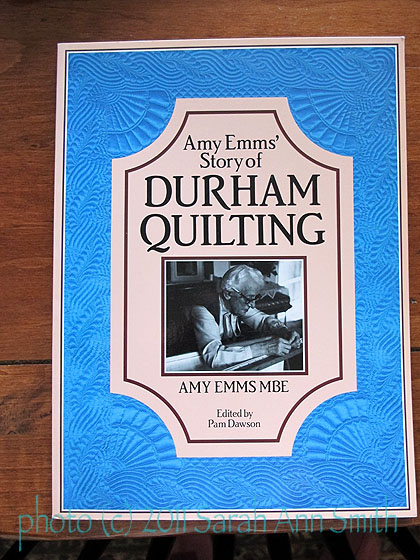
Saving the best for last, is Amy Emms’ Story of Durham Quilting, by Emy Emms MBE, Edited by Pam Dawson.

Amy Emms' Story of Durham Quilting

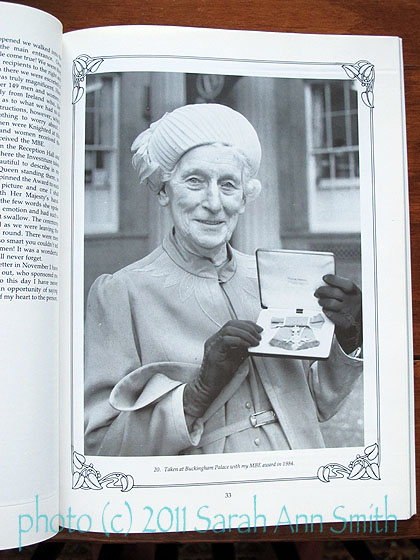
For those not familiar with British honors, MBE stands for Member of the British Empire, and is a very special honor.  This photo shows Amy Emms after receiving her medal,

Amy Emms receives her MBE

and the reverse side of this page shows the certificate signed by her Majesty Queen Elizabeth  in which she confers upon Amy Emms (getting goosebumps here) “The Dignity of an Ordinary Member of Our said Order”  and “Given at the Court of Saint James under Our Sign Manual and the Seal of Our said Order this Thirty-first day of December 1983 in the Thirty-second year of Our reign.”   Here’s a link to Wikipedia’s article on the MBE.  It is just astonishing to me and so wonderful that a woman was given this honor for being a quilter!

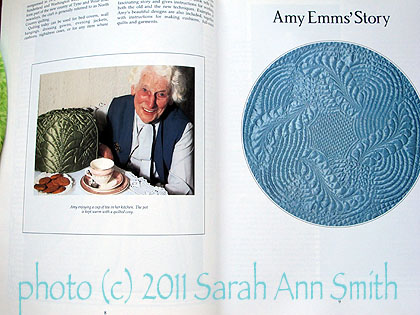
This photo shows the stunning quilting, North Country/Durham quilting, for which Ms. Emms is known, along with an utterly charming photograph of her having tea.

As you can see, her use of satin for her quilt (on right) and tea cozy (on left) shows off the incredible traditional hand quilting.

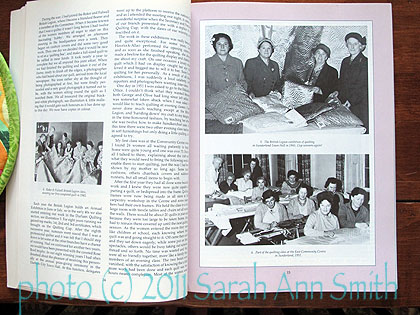
Amy Emms was a teacher, here in a photo from the early 50s.

As with Dorothy Osler’s book, I love that this book tells the story of quilting, the history of it, and documents that history with pictures–after all, we are quilters and LOVE the pictures!

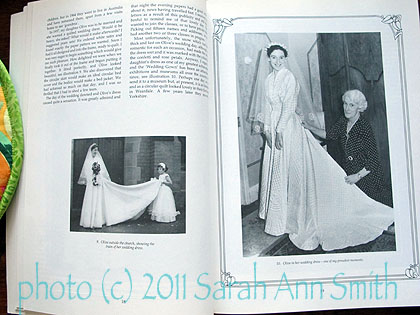
Amy Emms (on floor in photo on right) made her daughter's satin quilted wedding dress entirely by hand. The whole thing is quilted, and the bride looks so happy! Can't you see the family resemblance? I just love seeing the faces of parents in their children (including mine!).

This book is about Amy Emms’ story, first and foremost, though there are some projects.  At the end of its 96 pages it does include some patterns of typical Durham quilting, and in the middle there is “Start with a Cushion” (a pillow in the US–it’s that divided by a common language thing again), with photos of how Amy works on a pillow cover, her traditional peg-stretcher-bar frame, with detailed instructions on how to make this pillow.  For me, what I love is the history and the photos (both historical and contemporaneous)… including the caption next to a man in a red satin quilted robe (as he holds a beverage) “This warm wrapover dressing gown is suitable for a man or a woman, but you can also shorten it to make a smoking jacket for a man.”  Anyone know of any significant others that want a smoking jacket?  Times have changed, and I love that it is documented.

I promise you…one of these days, there is a really traditional quilt coming out of my studio….

and a PS:  for any of you in the UK, if you can add some context about the MBE, please do leave comments!


True to Life, 3

January 28th, 2012

True to Life:  Twenty-Five Years of Conversations with David Hockney, by Lawrence Weschler.

Here’s a quote of something David Hockney said  from True to Life:  Twenty-Five Years of Conversations with David Hockney, by Lawrence Weschler, that will resonate for quilters (p. 30):

“But these early collages were really more like studies:  you did them, just as you do a drawing sometimes, to teach yourself something:  it doesn’t matter what they look like when you’re finished, that’s not why they were made.  In this case, in retrospect, I realize I was training my visual memory, and this took a lot of time.”

YES yes YES! Those class projects are just that…learning experiences.  You learn the technique, then go home, practice and make it your own. And it also shows that even someone like Hockney, an acknowledged master, took the time to learn and develop his skills and “eye.”

And another tidbit… I’ve never really much cared for Cubism, that angular way of painting developed in the early 20th century by Picasso and some of his contemporaries.  But this quote made me  understand how those painters were exploring a new way of seeing (p. 33):

“Cubism, I realized during those few days,”  Hockney continued, “is about our own bodily presence in the world.  It’s about the world, yes, but ultimately about where we are in it, how we are in it.” [emphasis in book]

So how we do apply that to representational art quilts.  One thought that immediately occurs to me is that sometimes when I see art quilts of kids in fields and whatever, the thing that grates for me is that while the child may be well rendered–well done enough that if you saw that child come trotting down the hall, you’d recognize them as the child in the quilt–somehow the not-as-well-done of this sort of quilt will have a scene and a child, but not a child IN the scene… The most successful of these textile artworks convey the essence of the child being fully present in the place and time depicted.

And now we’ll return, for a time, to regularly scheduled blogging!