email Youtube

Home
Galleries
Blog
Workshops & Calendar
Store
Resources
About
Contact

Author Archive

Coming home to Maine

Tuesday, May 25th, 2010

OK, so in the last post I showed you the outbound journey from Owl’s Head (a Head, by the way, is a peninsula) airport. It’s always fun to see the Camden Hills rise up in the distance…you know you’re almost home:

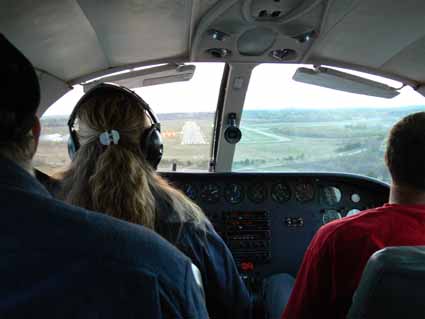
First, you can spot the runway as you approach.  This is what it looks like when you come home in not-winter (otherwise it would be pitch dark), as viewed down the short “aisle” and through the cockpit window:

Next you see all the buildings that make up the airport including the private aviation side.  I learned upon our return that sigh, sob, our ticky tacky little building will go the way of the Dodo bird this fall.  They are building a new “terminal;”  I will be sad to see our homely little old place gone, but I expect the folks who work there will be mighty glad to work in a building designed to BE an airport!

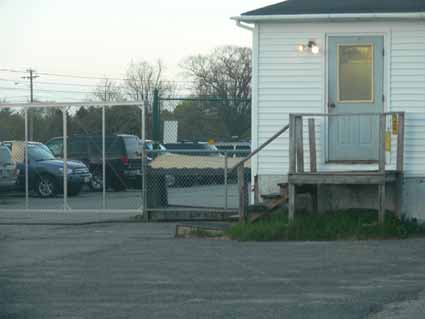
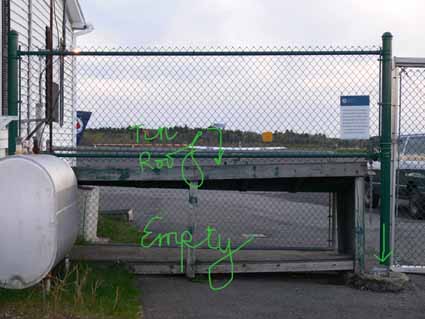
Then you spot the baggage return….this is from the runway side.  Please notice that corrugated tin roof to the immediate left of the white building.

You exit the plane, and walk into the “terminal,” go out the front door and down the splintery wooden stairs (the ramp is currently out of service due to rot, at least it was being worked on when I got home) and turn left to access the baggage claim area.

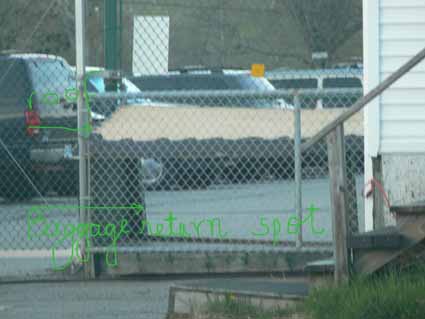
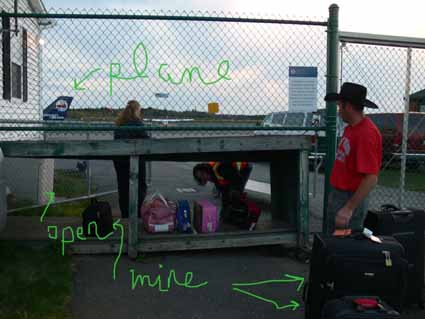
Yes, that opening in the chain link fence is the spot.  There is a locking gate on the back side to prevent deer, racoons, wandering pets, and other threats to national security from wandering onto the runway and getting access to one’s baggage. Here’s what it looks like from the front side–note the arrow on the right.

That arrow points to my favorite thing ever…our Baggage Claim sign:

Have I said recently, I LOVE MAINE!!!!!!!!  Here is the loaded up baggage claim “carousel”:

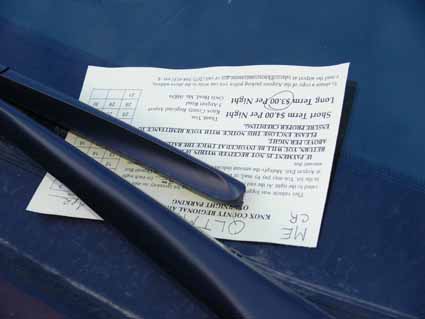
Next, to the Long Term Parking.  Short term parking are the 20 or so spots next to the double-wide.  It costs a bit more… all of $4 per day (charged by how many nights you are there).  You walk through the short term lot to the long term lot (which holds maybe 30 cars/trucks).  The only hazard is stepping into a pothole in the dark.  Cost:  $3 a night.  To pay, you go to your car and look at the windshield:

Yes, that card is your ticket to pay.  They mark the day you arrive.

You have ten days to mail your check in for the correct amount.  They actually neglected to put the card on my car for a week, so I paid them the extra 7 days anyway…   The major drawback to this system is winter.  The cards FREEZE to your windshield, and tend to disintegrate when you try to get them off.  Many times, you can’t, so you go home in the snow with the wipers on, and with every pass they scrape and rub off another layer of the card.  We make it work anyway.  It’s nice to be from a small town!

And one last bit of beauty…can you see why I love coming home to here?

This is not a minivan

Saturday, May 22nd, 2010

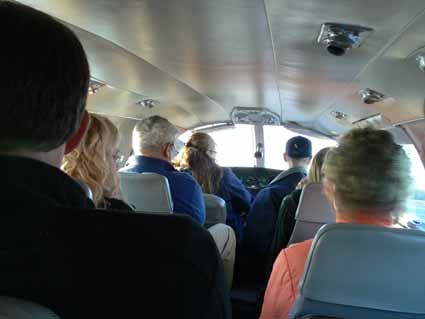
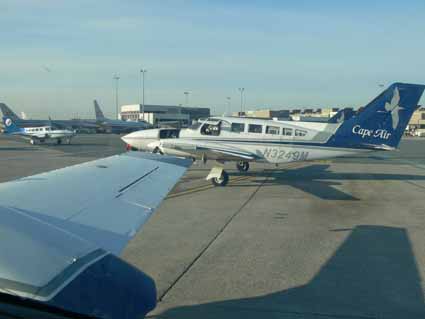
This is, in fact, the view from the last seat of the Cape Air flight from Owl’s Head Airport (officially it is the Knox County Airport in Rockland, Maine, but everyone call’s it Owl’s Head after the nearby little peninsula and light house) to Boston.

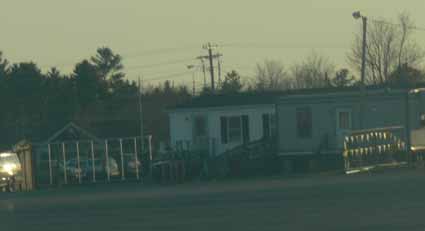
In the past, I’ve had some fairly hilarious conversations about traveling out of and in to Maine.  Two years ago, I had the great good fortune to teach at the Lowell Quilt Show, in Massachusetts, and ate dinner several nights in a row with a great bunch of teachers (lots of laughing, lobster, and some wine!).  One of the teachers said “well, I travel out of a very small airport, we have only ten gates.”  I just looked at her and blurted out “that’s nine more than we have!”  We all laughed out loud…then I added that our airport is actually an old double-wide manufactured (mobile) home:

Yes, that white and gray building is the airport.  All of it.  It leaks.  It is creaky.  The carbuncle / bumpout on the back is the extra waiting room added where you sit after you go through the TSA screening.  The only bathroom is on the outside of the screening, so if the urge hits, you leave everything inside the bumpout, run to the bathroom in your socks, and then pass through the detectors again.

Maine is a neighborly place.  Once, I got fogged out of my early flight and had to wait four hours for the next puddle-jumper to Boston.  One of the other passengers had forgotten her laptop power cord, so the desk agent said “You live on my way to the grocery store; I’m going to pick up some things before the next flight, want me to drop you at home on the way?” and off they went!  Anyway, speaking of puddle jumpers, here’s a picture of the 8-passenger seat (sometimes a passenger also sits in the co-pilot seat) plane, at Logan in Boston:

The baggage goes in the nose, the tail, and carry-ons go in the wings.  There is no on-board storage.  Even a large purse goes into the wing compartment!

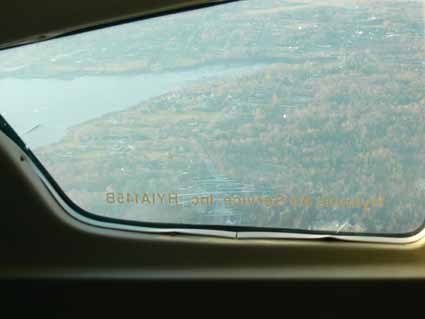
And this is a view out the window at Knox County, Maine, where I live:


And here’s a typical aerial view of the Maine coastline at near-dawn (I always take the 6-am-ish flight out so I can connect to whatever else it is I need to get where I’m going):

THIS congested view is what it looks like near Boston (i.e. the gateway to the rest of the world)–too many people!

Next…I’ll show you my favorite thing…coming home, the baggage return, and the “long term”  parking lot.  Stay tuned <GRIN>!

Beneath the Surface

Thursday, May 20th, 2010

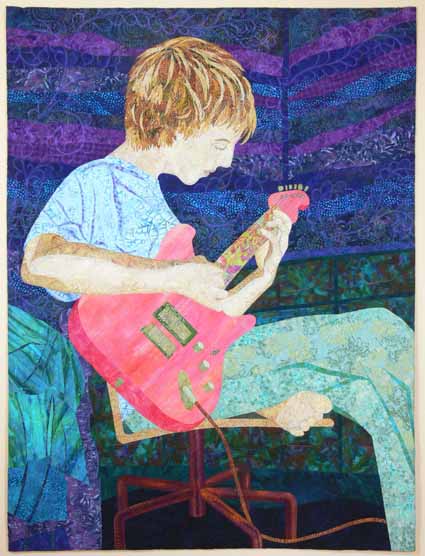
Jamie Fingal and Leslie Tucker Jenison came up with the idea for the Beneath the Surface exhibit, got the sponsors, juried the show, and are now doing a totally cool thing on their blog!  My quilt is the portrait of my son, Joshua (recently blogged about at length, so only a small picture here):

Jamie and Leslie have sent each of the artists a list of questions, and it looks like we’ll hit 100 percent participation with the answers.  Day by day they are adding the responses of the various artists to these questions:

1.  How do you describe yourself?
2.  What is your creative process?  planning, drawing, notes, etc.
3.  What’s your style?  Abstract, pictorial, surface design, whole cloth, etc.
4.  How long have you been a quilt maker/fiber artist?
5.  Do you listen to music when you make art?  what kind?
6.  What do you do when you are blocked creatively?
7.  Do you teach?  What’s your favorite part about teaching?
8.  Are there artistic endeavors that you have yet to do?
9.  How do you balance your family life and art?
10. What is the best part about what you do?

If you’d like to see what I said, check out today’s post, here.

To see what all the others have said, go to the Dinner at 8 Artists blog and just keep going backwards through the posts!  It’s wonderful reading!

Thanks to Moore’s sewing centers of southern California and Brother Sewing Machines for sponsoring the debut of the exhibit at the International Quilt Association show in Long Beach and to MistyFuse / Attached Inc. (loyal readers KNOW  how much I love MistyFuse!) for sponsoring the continuation of the exhibit at International Quilt Festival in Houston this coming October/November.  I’m so glad it will travel to Houston, since that means I’ll get to see it in the cloth!

Janome Horizon 7700

Tuesday, May 18th, 2010

How time flies when you are swamped?  I can’t believe it has been more than a week since I posted!  Anyway, I’m here, well, but trying to get caught up and blog about a very busy past month-plus!   One of this first things I want to tell you about is a new sewing machine, and YIPPEEEE SKIPPPY it looks like I’ll be getting one!  It is the Horizon 7700 from Janome.  If you click here you can learn more about it directly from Janome.

If you are familiar with the Janome 6600 (which is what I’ve been using since it came out in early 2005), you know that Janome makes great machines and sells them at a great price…you get many more features for your purchasing dollar than with other companies (whom I shall not name!).

I got to do a quick test drive at Maine-ly Sewing (in Nobleboro, Maine) not long ago, and I am in SERIOUS machine lust!  I totally love my  6600, but they have taken the 6600 and made it better.   They’ve added automatic tension, more harp space, more lighting (my aging eyes are joyful!), and some really fun decorative stitches.  Here is one of my quickie test-drive pieces:

There is this awesome “straight stitch” throat plate thingie… if you use the programmed stitch for free-motion, it automatically moves this piece of the throat plate to make it single-stitch (a dot or small circle) opening instead of the usual rectangle (so you can stitch a zigzag).  When you go back to regular stitches, the thingie retracts and you’re back to the rectangle, and thereby don’t slam your needle into throatplate…ingenious!
When I did my quickie test, I used the accu-feed (the built-in walking foot mechanism) to do some of the satin stitches and decorative satin stitches, then popped on the free-motion foot.  The stitching was wonderful…

When checking out a new machine, I always try to make a machine do poor stitching, deliberately make “driver errors”.  The easiest one to do (and common with beginning free-motion quilters) is to whip around curves, which usually leads to eyelashes on the back.   I did   several spirals and whip-around curves,

and I tell you the back was almost *perfect*!  I couldn’t believe my eyes.   Some of my stitches were really long…like 3/8 ” for each stitch, and still, the stitches were either just right or only the itsy bitsiest bit of needle thread showing like a little dot on the back.  I am seriously impressed.

I am also on the list to get a 7700!

I was a bit hesitant before my test drive because of the 7700’s touchscreen and dial, as I am VERY visual and prefer buttons and knobs.  Often, at least with the old touchpads, my fingers were too cold and somehow the things wouldn’t work for me (much muttering at the grocery store!).  I sat down at this machine and was able to use the touchpad only to scroll through the screens (it was intuitive and easy) without even reading the manual (smacking my own knuckles, I know). I didn’t try to figure out the dial, as I had to meet someone and was short on time.

Anyway, I was very happy with what I saw and am looking forward to getting one and playing a lot!

PS…in the interest of full disclosure, Janome America has provided me with an artist/teacher loaner for the past six or seven years or so.  In exchange I did a couple patterns for their now-defunct company magazine, and they used one of my quilts in their show brochure ads several years ago.  I also sometimes send them   suggestions I hear from the 6500/6600 yahoo group (with the permission of the authors or, in the case of multiple comments of the same variety, edited into non-attributable/generic suggestions by me).  Anyway, about 18 months ago they actually wrote back to me and asked for clarifications on a couple of things–they were clearly in the planning stages on the 7700 and they were (WOW) listening to their customers!

Bottom line:  I’d say the same things if I had a loaner or paid full price…the 6500, 6600 and 7700 are some of the best machines on the market, and at a good value for the price–and a fraction of the cost of some comparable machines from other companies.

Cheers, Sarah

PS—just discovered Janome has a really good set of introduction pages on their website to showcase the features of the Horizon 7700.  Check it out here.  Be sure to click on the various tabs (features, accessories, projects, etc).

Joshua, the quilt in progress and done! #6

Sunday, May 9th, 2010

With this blogpost, we will end the series on how I made the quilt of my son playing guitar.  I had fun with the quilting, too.  Here’s the bucket and bag of threads I used for the quilting:

And here is the completed quilt; notice that the proportions have changed a little.  The finished size for the exhibit is 36 inches wide by 48 inches long, so I needed to remove some extra, especially in the length.  If the quilt hadn’t been in this exhibit, I might have let it go a little longer, but I think in terms of design and composition it is still fine the way it is.

While I was mulling over how to quilt the walls, there was yet another discussion on either QuiltArt or SAQA (or both?) about the line between traditional and art quilting.  As usual there were those who want nothing to do with traditional quilting.  I, however, am proud of our traditional roots and proud of this as an art form that began with women’s work.  As someone recently said to me, Quilt is NOT a four-letter word!

This discussion led me to the idea of using traditional feathered vines for the background quilting.  As you can see from this next photo, though I chose a thread I thought would show up on the background, it was too subtle.  I decided to echo-quilt around the feathered vines, then pencilled in the resulting space/channel to define the outlines of the vines with Prismacolor Pencil (which I later covered with a combination of a textile-friendly varnish and water to seal it to prevent it from rubbing off).

Here is a wider-angled shot of the wall area showing the feathered vines…I just love them!

This shows the quilted quilt with the threads distributed over the top where they were used:

Here are two close-ups of the quilting of Joshua’s face and torso:

I love the backs of my quilts, the line drawing look, so took this (alas blurry) photo–you can see the feathered vines clearly on this semi-solid background fabric, and that the entire quilt is stitched 1/4″ apart or close… a lot of thread!

And to end where we began, but arrayed nicely, all those beautiful threads ( all but one of them Superior Threads):

PS–I am reminded by the comments to add that Joshua –hallelujah!– actually likes the quilt!  Given how picky teenagers are, especially of pictures of themselves, I am so thrilled that he of all people likes it.  Hugs to my firstborn!  Now…. what will the years bring that I can do another quilt, this time of secondborn son?