email Youtube

Home
Galleries
Blog
Workshops & Calendar
Store
Resources
About
Contact

Archive for the ‘Videos by Sarah’ Category

Embroidering Frank! Isn’t he Handsome?

Thursday, January 15th, 2026

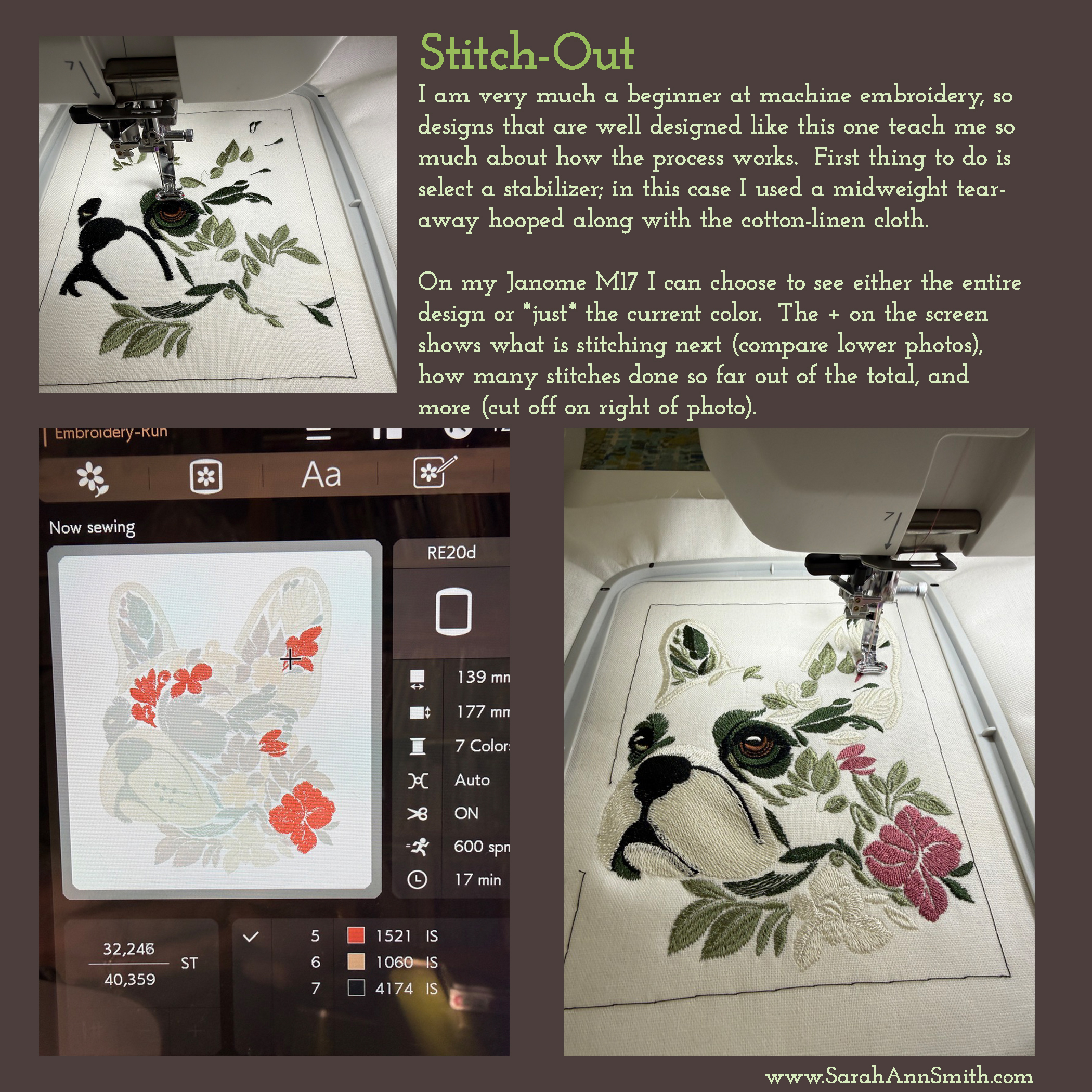
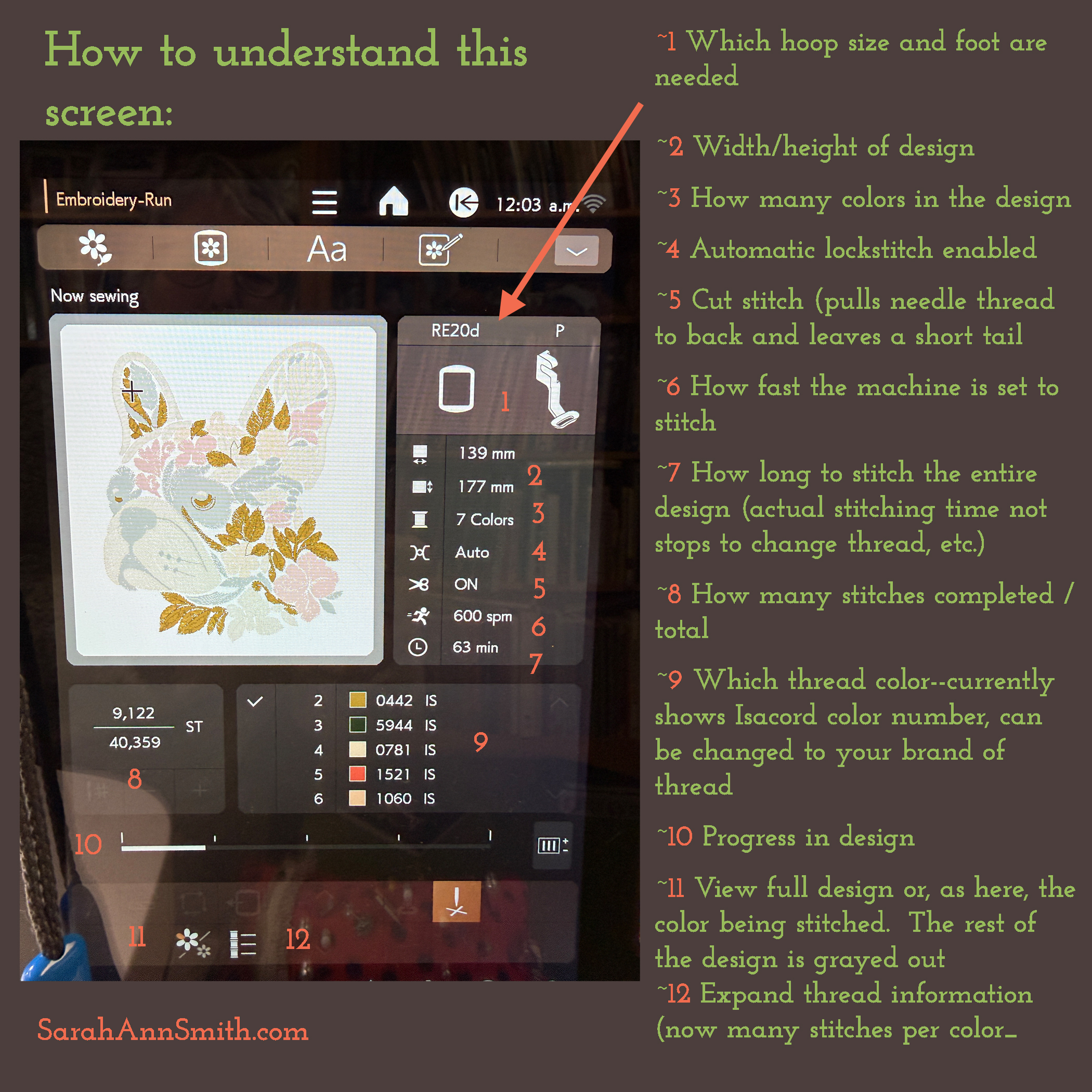
For my January 2026 Artisan project, I’m sharing a few of the gifts I made in the past two months since they are now given and public!  At long last I have conquered my greatest hurdle with the *enormous* Janome M17 combination sewing and embroidery machine: learning how to use the Artistic Digitizer software (remember, I’m a completely new to machine embroidery, just learning what the correct words and phrases are to ask how-to questions).  The M17 is brilliant and easy to use, but I tend to learn by clicking here, clicking there, and not following a linear progression. However, going through — step-by-step and in order — the MANY tutorials Janome has made available has been amazingly helpful.  A huge thanks to Janome Educator Anne Hein who has made so many of these tutorials; they are available on the Janome YouTube Channel .  There’s also another valuable resource in the Janome Artistic Digitizer FB group (AD is the Janome software–there is a second group called Artistic Digitizer, but it is a private group, not-affiliated with Janome, and questions don’t get answered as frequently).  I am quite the beginner with machine embroidery, but thanks to these resources and help from Anne and the participants in the FB group, I have learned SO MUCH in the past 8 weeks!  It is a testament to the machine and tutorials as well as Roksolana’s brilliant design and digitizing (more on that in a minute) that I have been able to do so well.
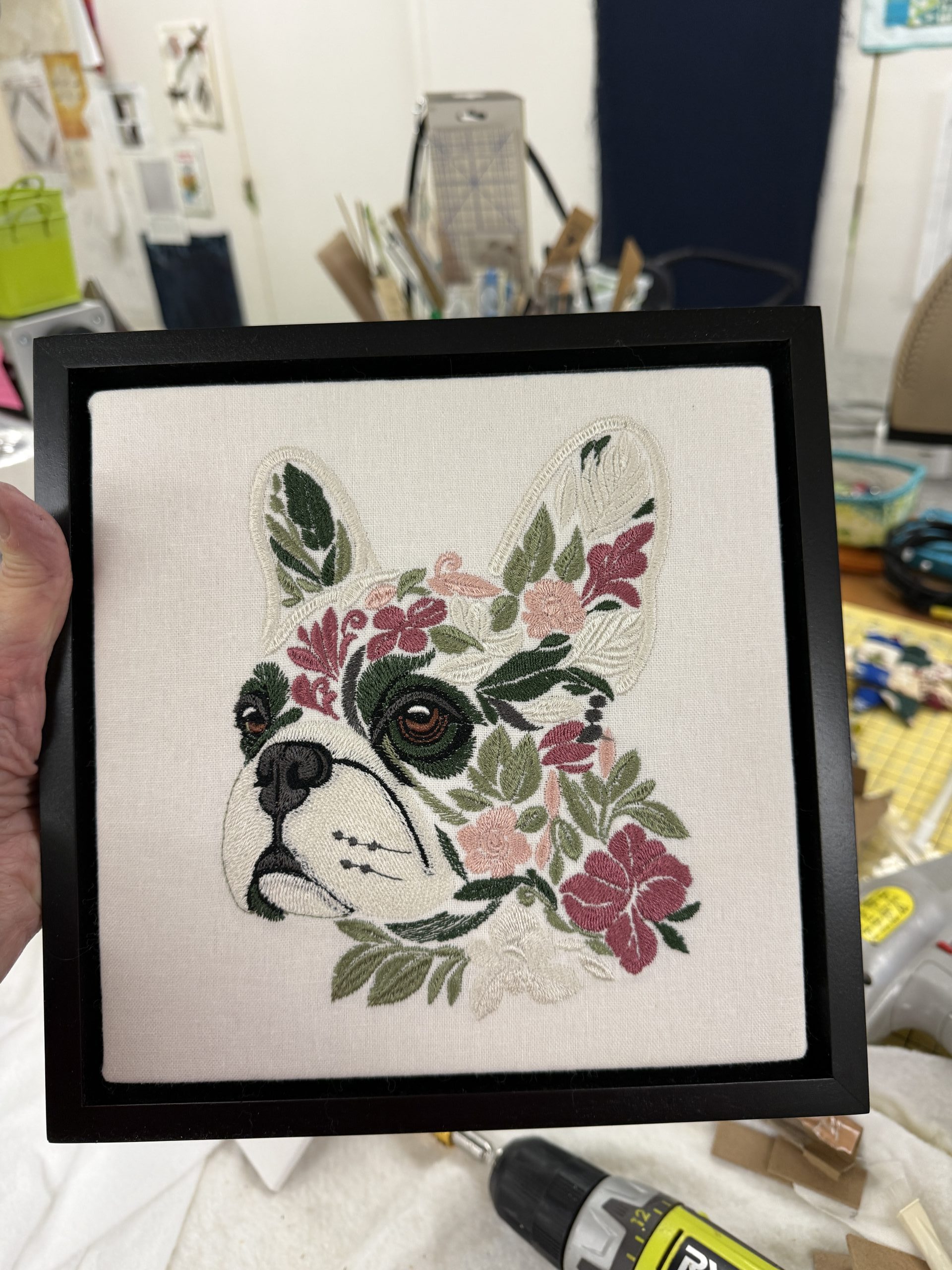
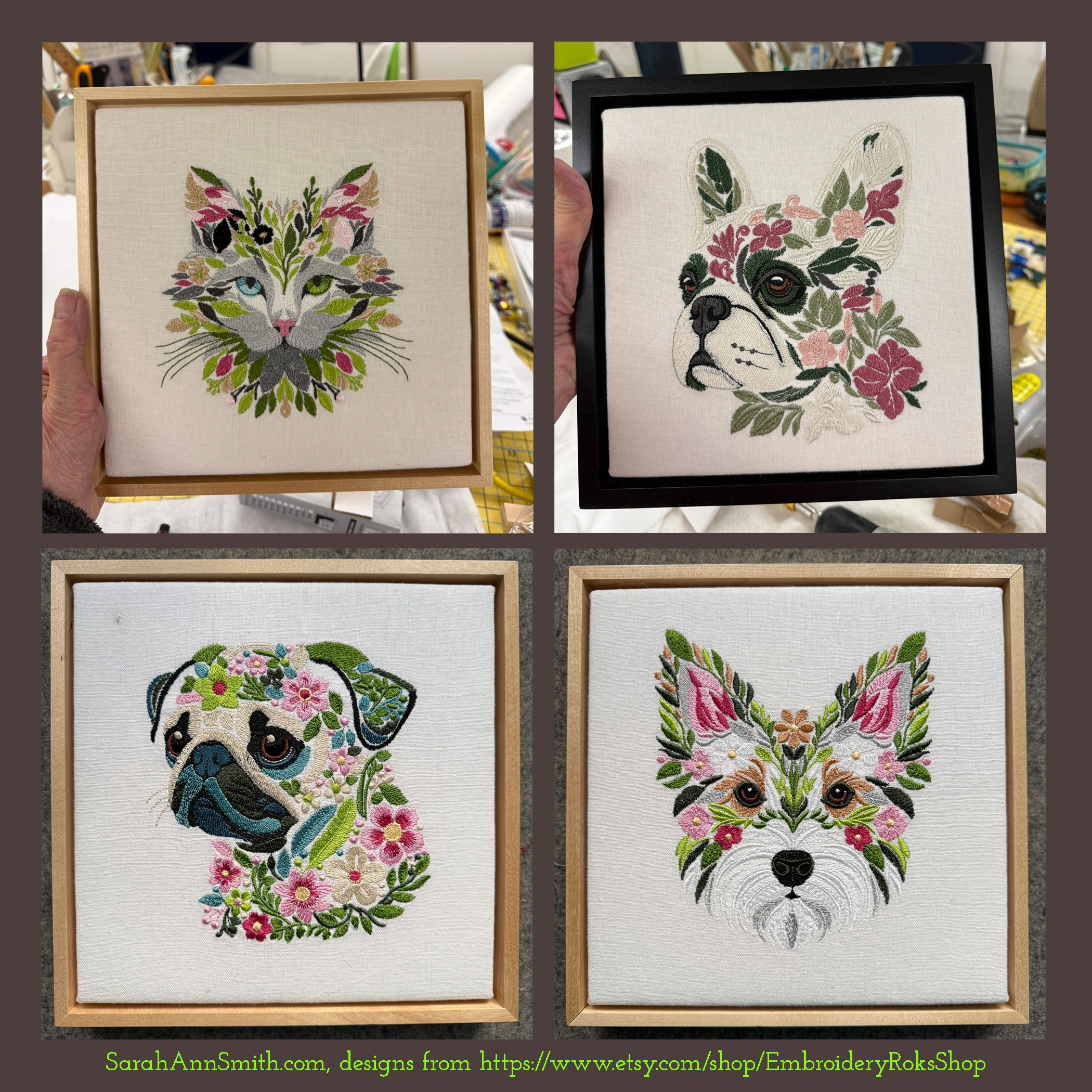
Frenchie embroidery design made by Sarah, design by EmbroideryRoksShop on Etsy

Frenchie embroidery design made by Sarah, design by EmbroideryRoksShop on Etsy

You can purchase this design and her other gorgeous artwork at https://www.etsy.com/shop/EmbroideryRoksShop .  I’m not affiliated in any way other than being a Very Happy Customer.  There are all sorts of animals–I bet you’ll find your favorite.

Here’s a short video on the process.  There is a longer video below, from near the end of the embroidery process.

And here’s that longer video (also on my YouTube channel):
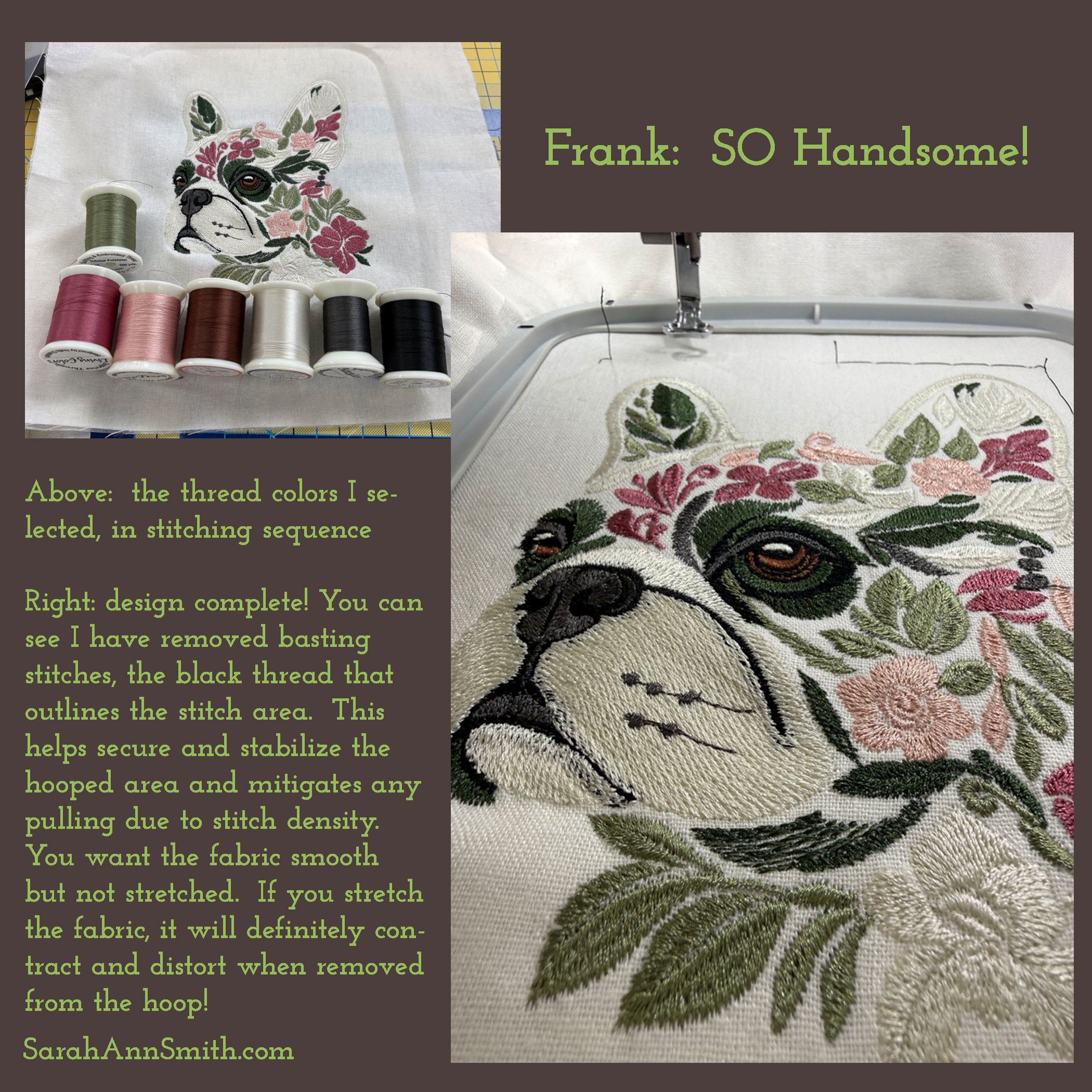
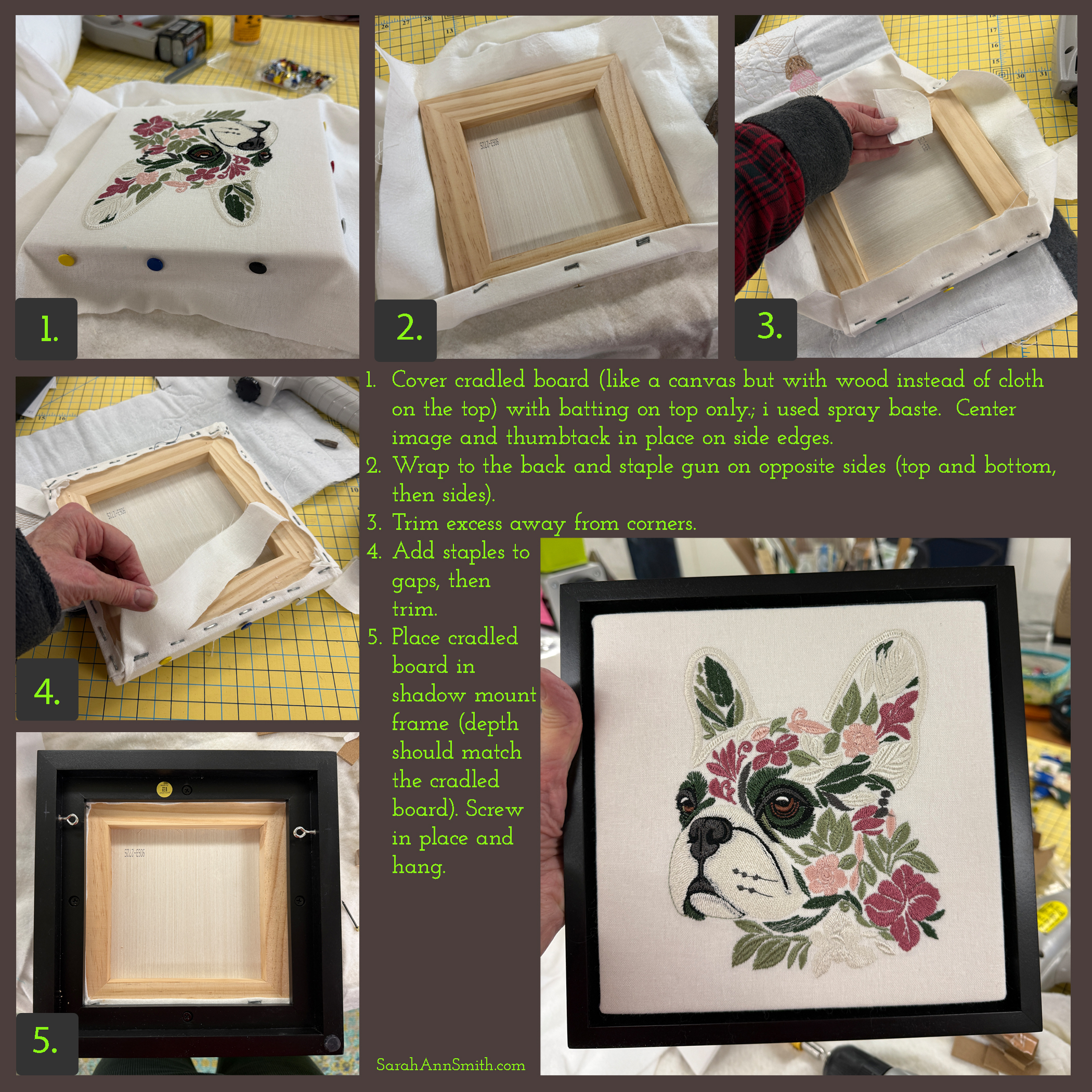
I also made three other designs by Roksolana.  By the way, it was a bonus (for me anyway) to be able to purchase from a young artist living in Kyiv, Ukraine, and I learned that for at least a time Etsy isn’t charging their usual fees to folks living in Ukraine and trying to survive the war.  She is a mom, and the war affects them daily (like having electricity long enough to do the laundry!).  I had a delightful chat (with help for her using a translate app so we could converse) with her when I wrote to ask permission to use her designs for this Janome project.  DO go check out her Etsy shop here.  I was so excited when I found it–at last some designs that were not cutesy, or hearts and bows, or juvenile.  REALLY COOL designs!  I was at first a little concerned as I wasn’t purchasing from a “known” design company, but that is what makes these so fresh and appealing to me.  I needn’t have worried.  Just seeing how the designs stitch out I could see she really understands and masters the computer part of the work–getting the stitch flow to enhance the curves and lines and contrast in thread… like what follows!
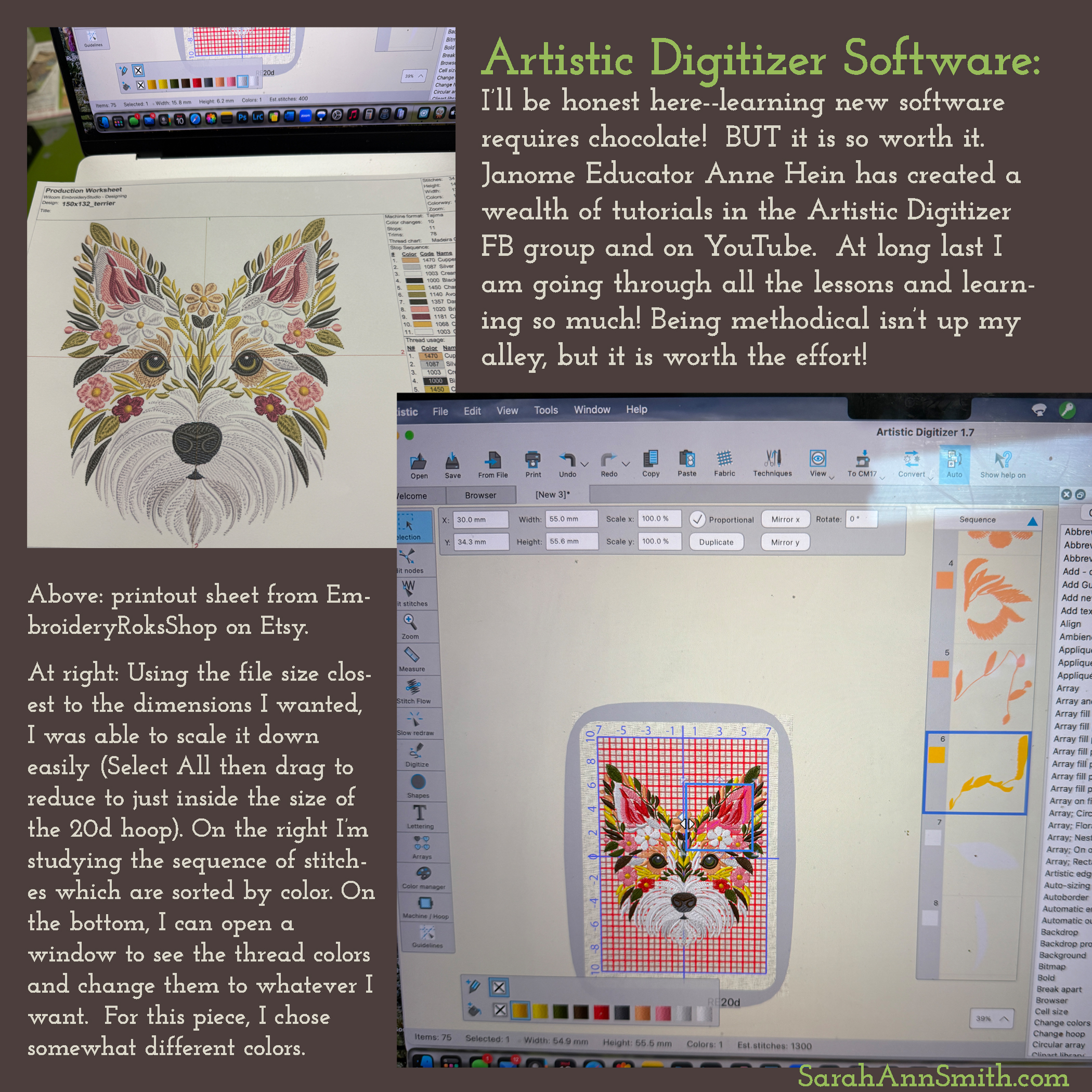
Roks’ colorways are fantastic and were the reason I first stopped because they are perfect for Ashley.  But I was able to select thread colors to use my Superior Threads and Isacord threads stash–I have literally hundreds of colors, so as long as I have enough thread on the spool, I’ll use what I have until I need to replace.  Then I think I’ll move to Isacord because of quantity on a mini-king spool and wider range of colors.  Must. Buy. A ColorCard!
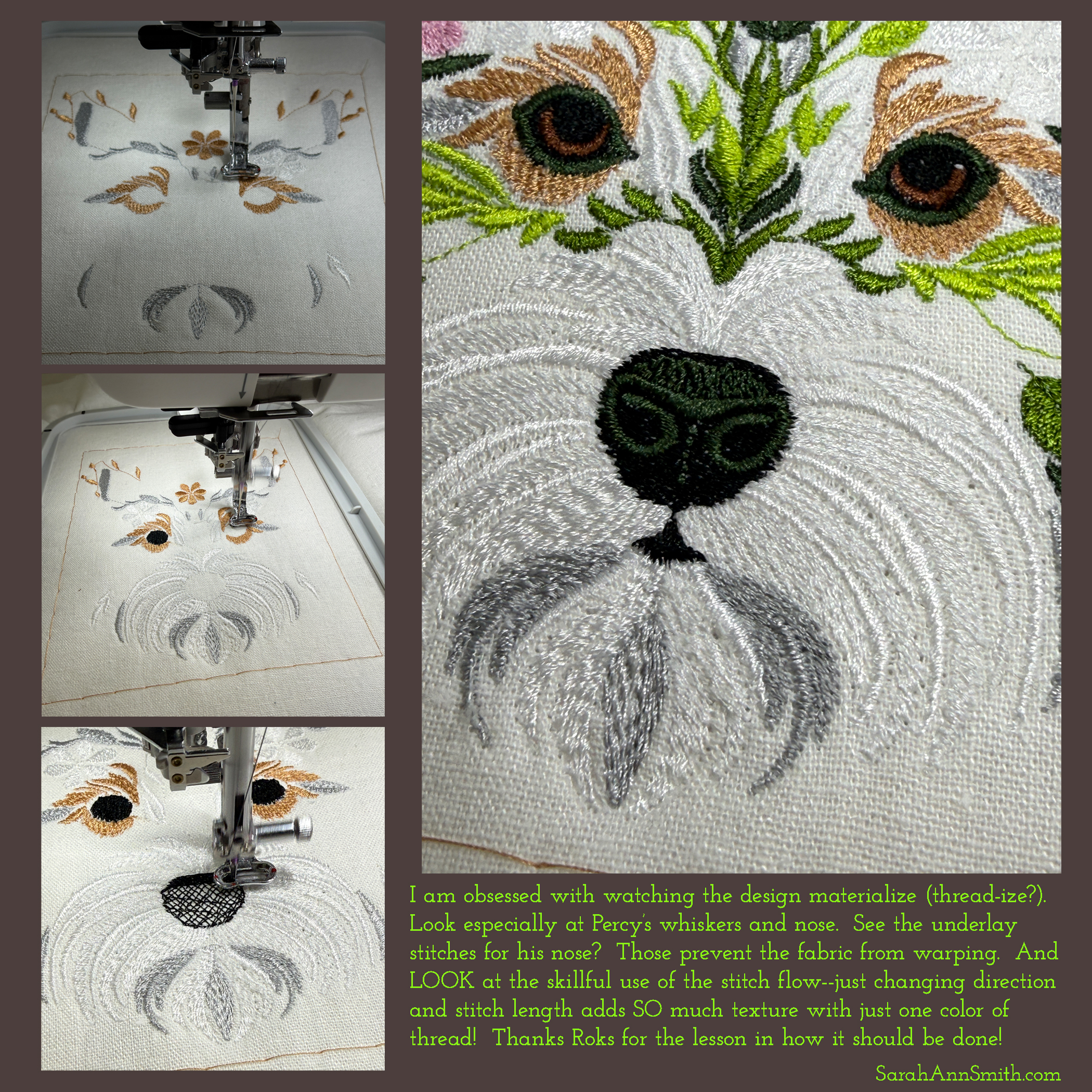
The design in Roksolana’s shop is for an Australian Terrier, but with the white thread and flowers, does this not look Just. Like. Percy?!!!!  AND THAT NOSE… I LOVE both noses…the stitched and the real one!

Yes, he sits in the corner of the kitchen cabinets. All. Of. The. Time. That was also the dearly departed Pigwidgeon’s spot, too. So I still have to lean over a dog to cook! This may be the first time in my entire 68 years that I’ve loved a photo of my back side LOL! That face, with the folded down “I Love You” ears!

Below are all four of the portraits I did.  In the top left is Boo, my husband’s spirit animal who went to the Great Poo Pan in the Sky way too young, at age 5 (he had some sort of tumor or something and went so quickly).  He was a Turkish Van:  all white except for a dark smudge over his right eye, which I was able to replicate by stopping the machine at the precise moments needed to change thread from greens to black for the location of the smudge.  He was also what is known as “odd-eyed:” One blue eye, one yellow green.  I am no longer terrified to stop the machine mid-stream to change threads, replace bobbins, back up a stitch or two as needed, and can anticipate pretty well when to hit stop!  I’m learning!

Top right is, of course, Frank, my GrandDog.  He is so darn cute and makes the most adorable sounds (and let’s be honest, yeah he kinda farts, too).  He and Percy are about the same size so Percy doesn’t have any issues with him (Percy is afraid of the neighbor’s Goldens who resemble Tigger going boing boing boing and tripping all over him), but Frank is a full ten pounds heavier, all dense bone and muscle.  Bottom left is a younger pug than the dearly departed Pigwidgeon (one of the true loves of my life), but it’s a pug!  So I made him and the terrier for Percy and they will hang in my upstairs studio (son’s old bedroom, my regular studio is in the basement and I have an attitude problem about being underground, so I relish having a  WINDOW).

And that’s it for this post!  If you aren’t already, follow me on Facebook, YouTube and Instagram, all are @sarahannsmithq .  I’m also the same handle on Ravelry if you’re a knitter.  THANKS for reading this post!


Plaid Top Tutorial: Lesson 4- Overcast Seams, just like Serged Seams

Tuesday, February 28th, 2023

Nothing beats a beautifully finished garment, one that is so pretty on the inside that you enjoy it every time you put it on.  Though you might be tempted to wear it inside out it’s so pretty, it remains a secret just for you!  Top technique for a beautiful inside is using a seam finish to hide the raw edges.  Not only does it look nice, it also protects the edges of the fabric, prevents fraying, can improve the way the seam functions, and contributes to a garment that will last longer.  After all, you’ve spent money and, more dearly, time creating so enjoy it longer!

Please note:  I am affiliated with Janome as a Janome Artisan and am compensated.  However, my reviews are honest and I would say what I say whether affiliated or not.  I’ve also chosen to be affiliated with Janome since 2003 (!!!) because their machines are so good and they are so responsive to the interests and needs of their customers.

The next several lessons/posts will be about all these seam finishes. We’ll start today with the fastest and simplest, the overcast seam.

There are many ways to finish seams.  Today I’ll review one of four methods and suggest why you might choose one over the other. I’ll do the other finishes in subsequent posts so this doesn’t get too long!

  1. Serged or overcast edges
  2. French seams
  3. Flat-felled or lapped seams
  4. Hong Kong finish seams

Overcast:

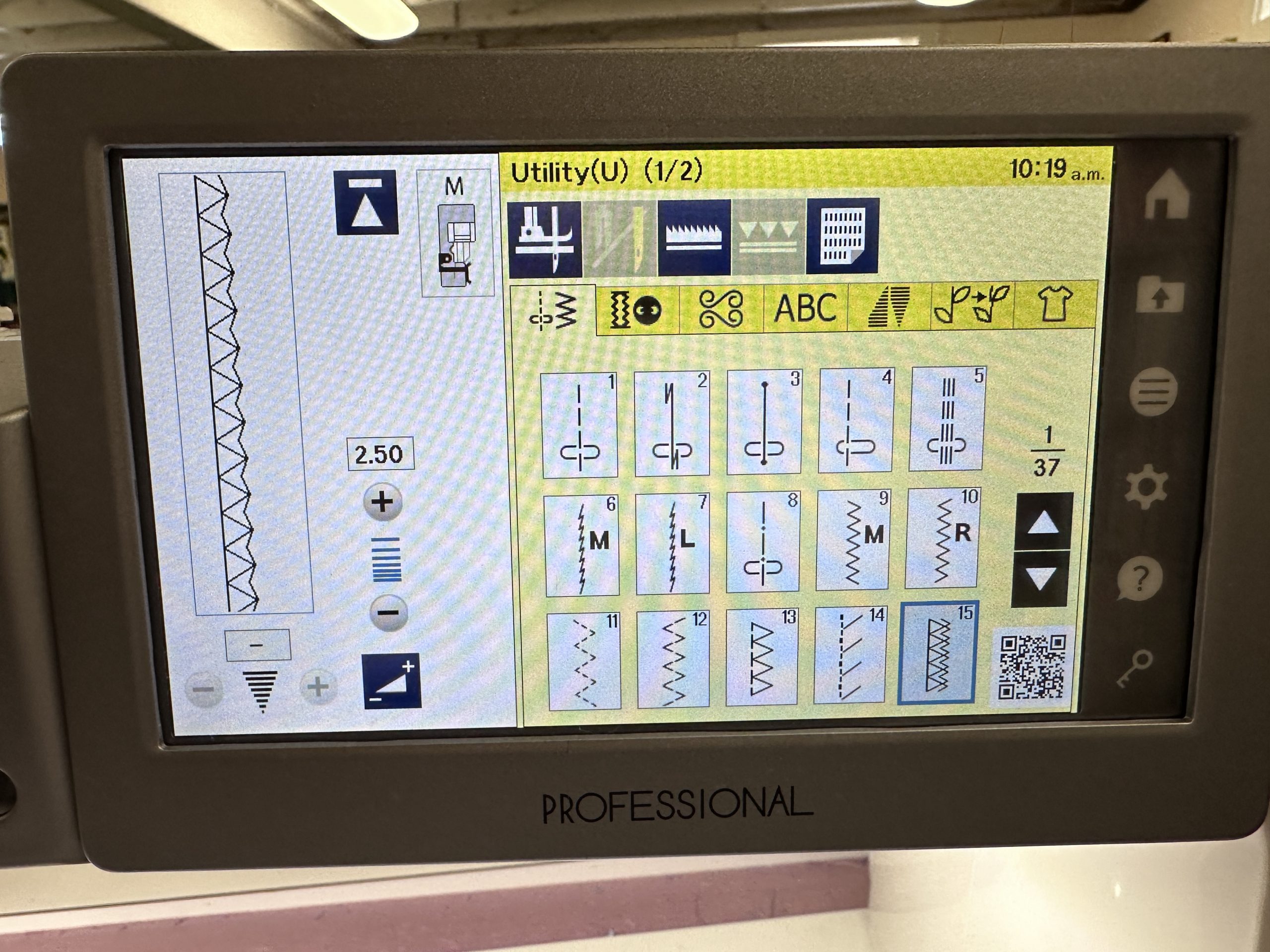
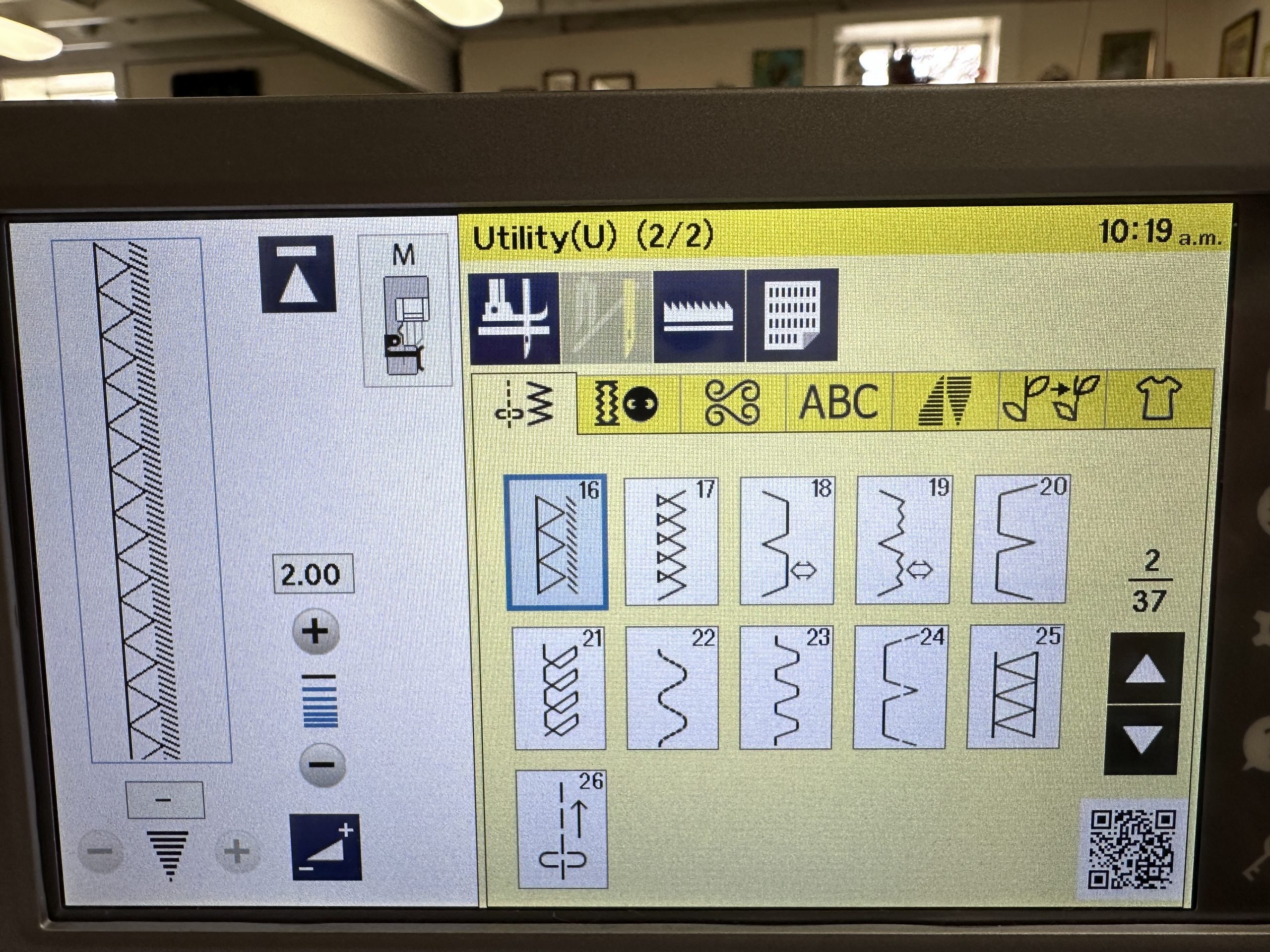
The first seam finish we’ll talk about is perhaps the most well known because it is fast and is used on the majority of commercially made garments:  serged seams.  These are made with a serger machine, which you might not own.  But if you have even a very basic sewing machine (more than straight-stitch-only), you will likely have at least one utility stitch that is called an overcast stitch.  On my machine, here are some of the choices:

My Janome M7 Continental has a wealth of stitch choices, but even the most basic machines have stitches similar to 13, 14 and 15 (and see next photo for more choices).  I particularly like stitch 15 which has an extra narrow zigzag on the raw edge.  You can see that you can (within a range) adjust length and width. At the top right of the white portion of the screen, the machine tells you which presser foot to use, and the bottom right of the yellow portion has a QR code you can scan with Janome’s exclusive AcuSPARK app (free in the app store for your device) which works with select higher end Janomes.

This screen, the next one in the sequence on my Janome M7, has additional overcast and hem stitches.

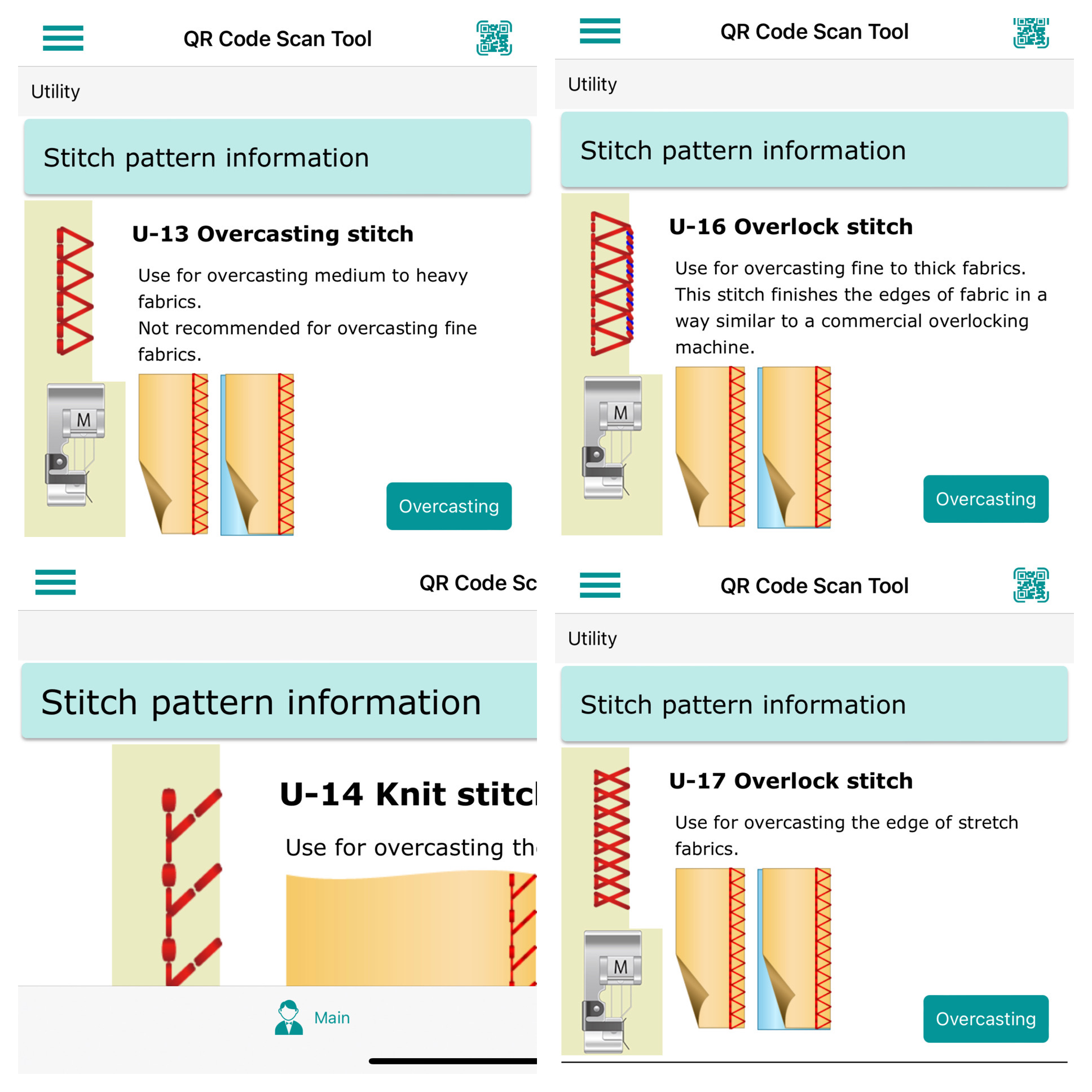
If you want help understanding when and how to use a given stitch, open the AcuSpark app and scan the QR code.  It then opens up a screen in the app with all sorts of nifty information on how to use the stitch. Below, I’ve opened the app to the Scan tool and took screen shots of these four overcast or overlock stitches.

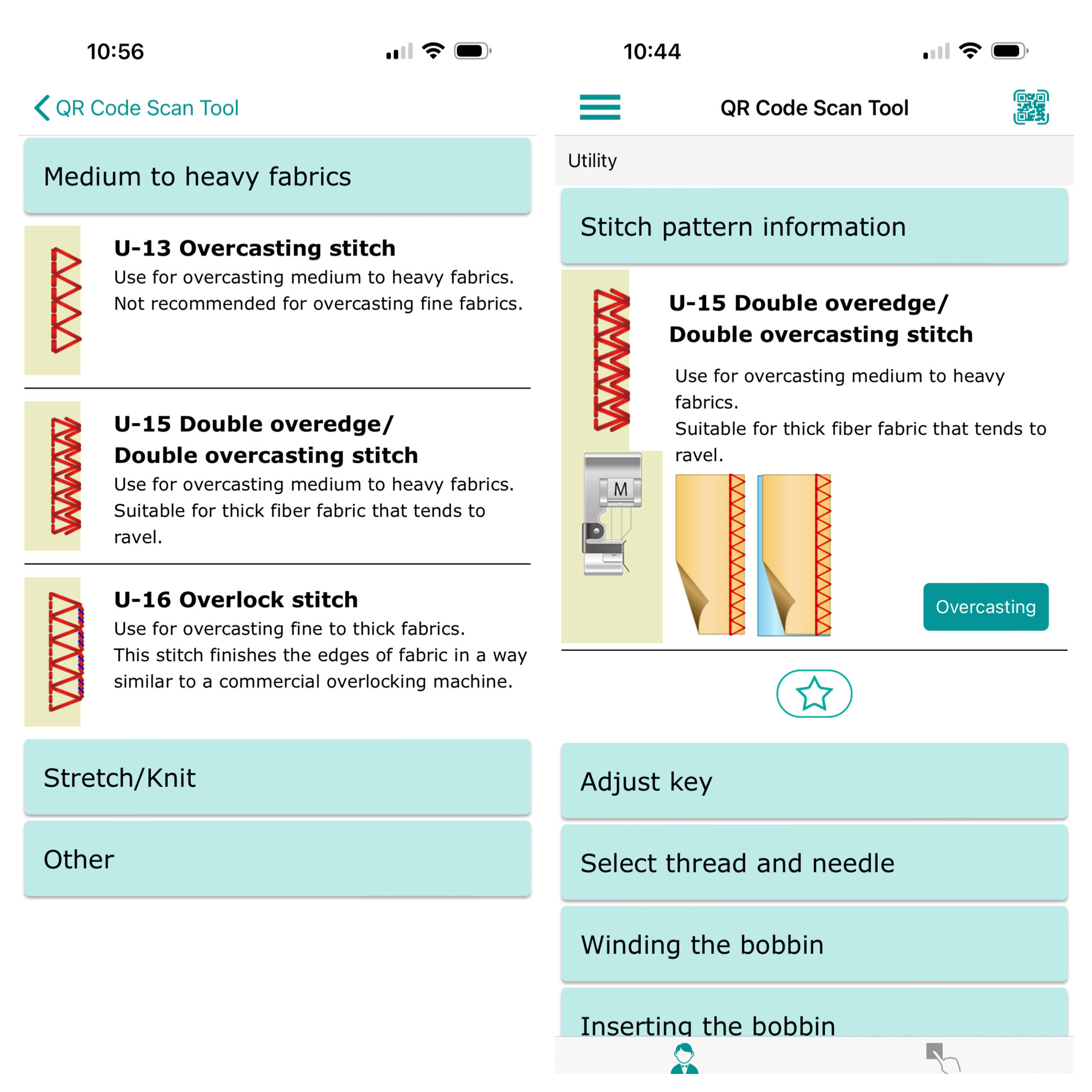
There is also a tab to look at various options, on left side of photo below and, on the right, the stitch I like.


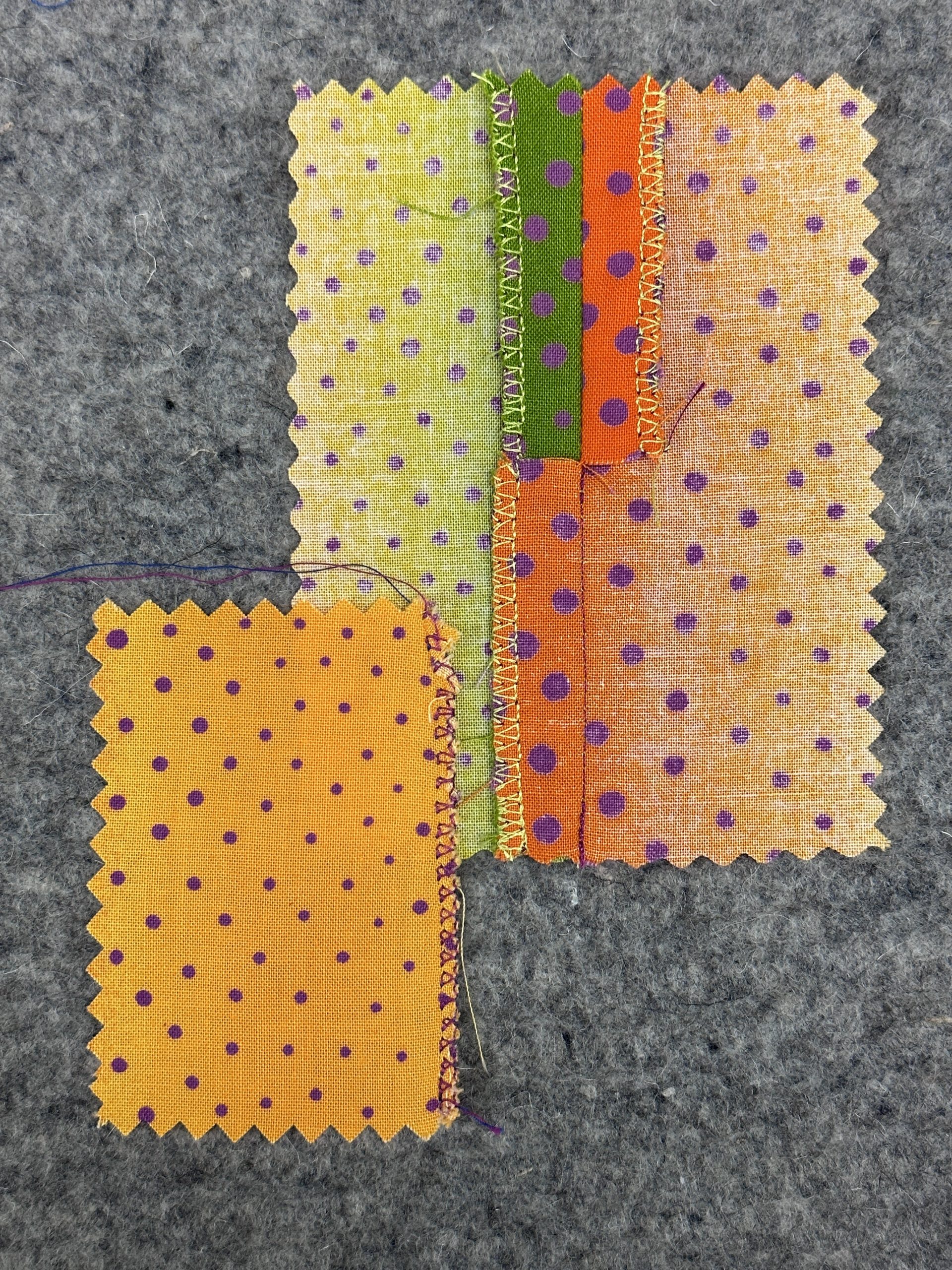
And let’s look at what a difference using the correct presser foot makes!  Be sure to watch the video at the end of the post to see this foot in action!

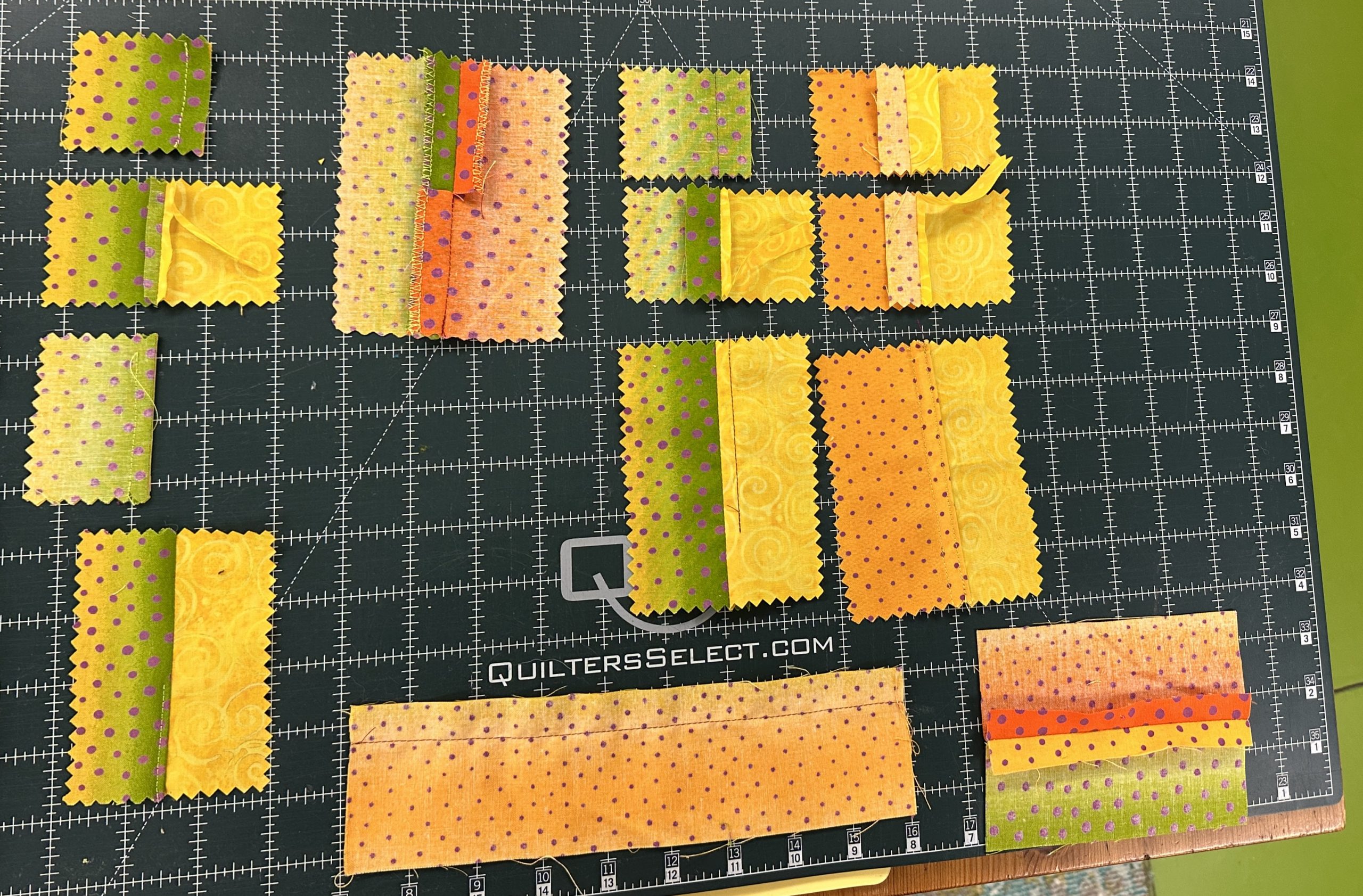
The small sample, lower left, shows using the overcast stitch with the regular presser foot. Messy! The larger sample shows overcasting each side of the seam with the “M” foot,  with the seam pressed open at the top AND overcasting both sides together and pressing to one side on the bottom.

Most machines that offer these stitches also come with (or you can buy separately depending on brand and model); buy one made by the company that made your machine for best results) a foot that has a wire on the right.  This allows the stitch to form properly and not pull or curl the edge; those distorted edges aren’t as comfortable! On the Janome, it is the “M” foot.  Look at the difference between the samples above.

Check the feel of the seam on a scrap.  Adding too much thread can make a seam stiff and uncomfortable.  If you have/can find a lighter weight thread, that finer thread will make the seam softer, as will using a longer stitch length IF your machine allows any adjustments to stitch width and length.  If so, and your fabric ravels a lot, you may choose to use a wider stitch setting to better encase the tendency to ravel and wiggle.

USAGE:  pretty much any seam, especially where seams intersect and you’d end up with a lot of bulk.

When I was doing custom home dec sewing for an interior designer, I also used a serger (but you can use the overcast stitches) to secure each cut piece of fabric before constructing the pillows, duvets, curtains, bedskirts, seat cushions and such. Upholstery fabric is VERY ravelly, and expensive, so I secured the edges immediately after cutting and before assembly to prevent an expensive disaster.

Cons:  not the classiest finish, but fast and functional.

Here’s a video!


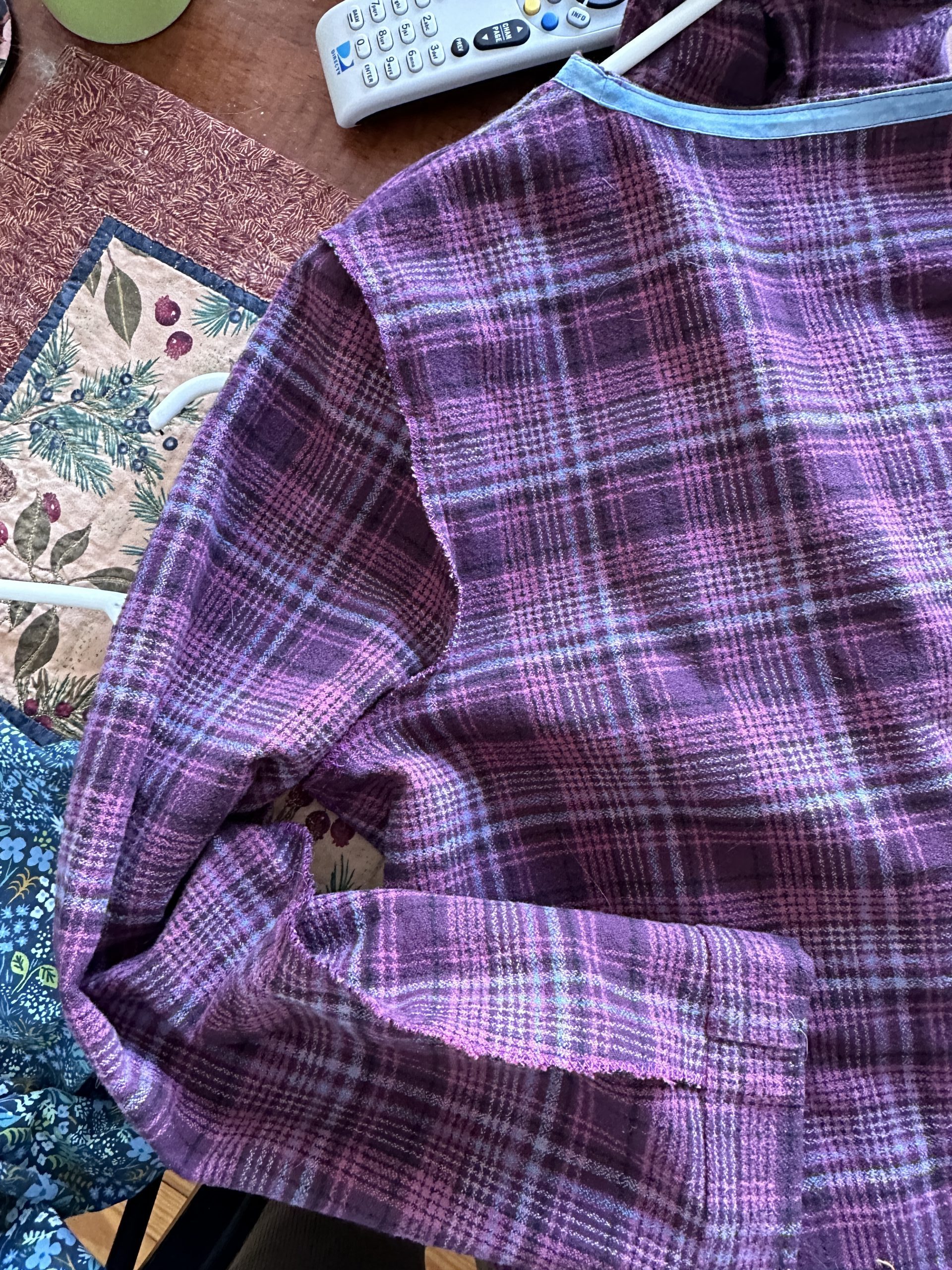
On the Plaid top I used serged together seam allowances for both the underarm and sleeve-to-body seams.  This choice is especially useful where the sleeve joins the body because it stiffens the seam just a bit.  When you press the seam towards the sleeve it actually helps support the top of the sleeve itself and helps it to hang well on the body.

Inside of the Plaid top: I used the overcast-both-seam-allowances-together method.

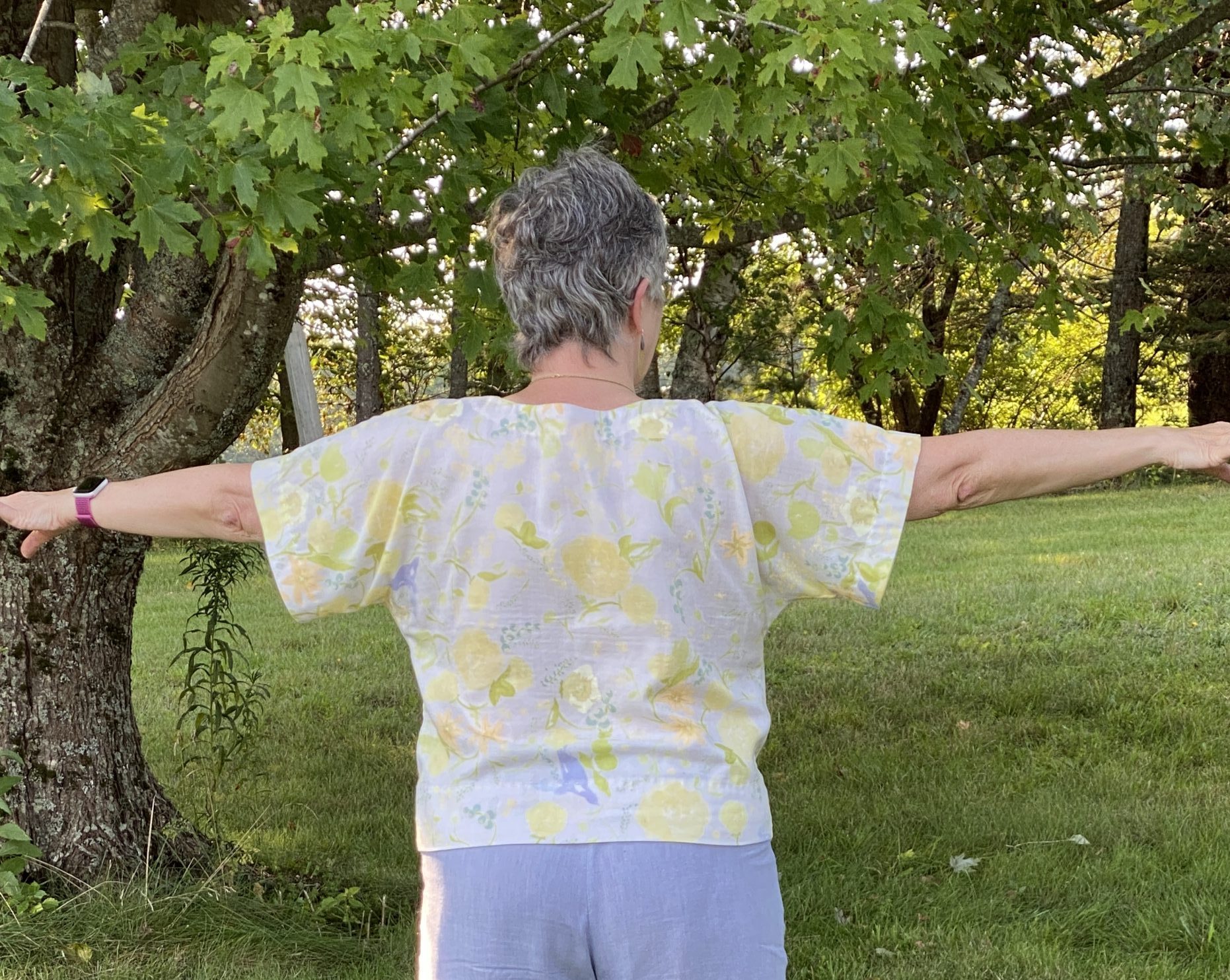
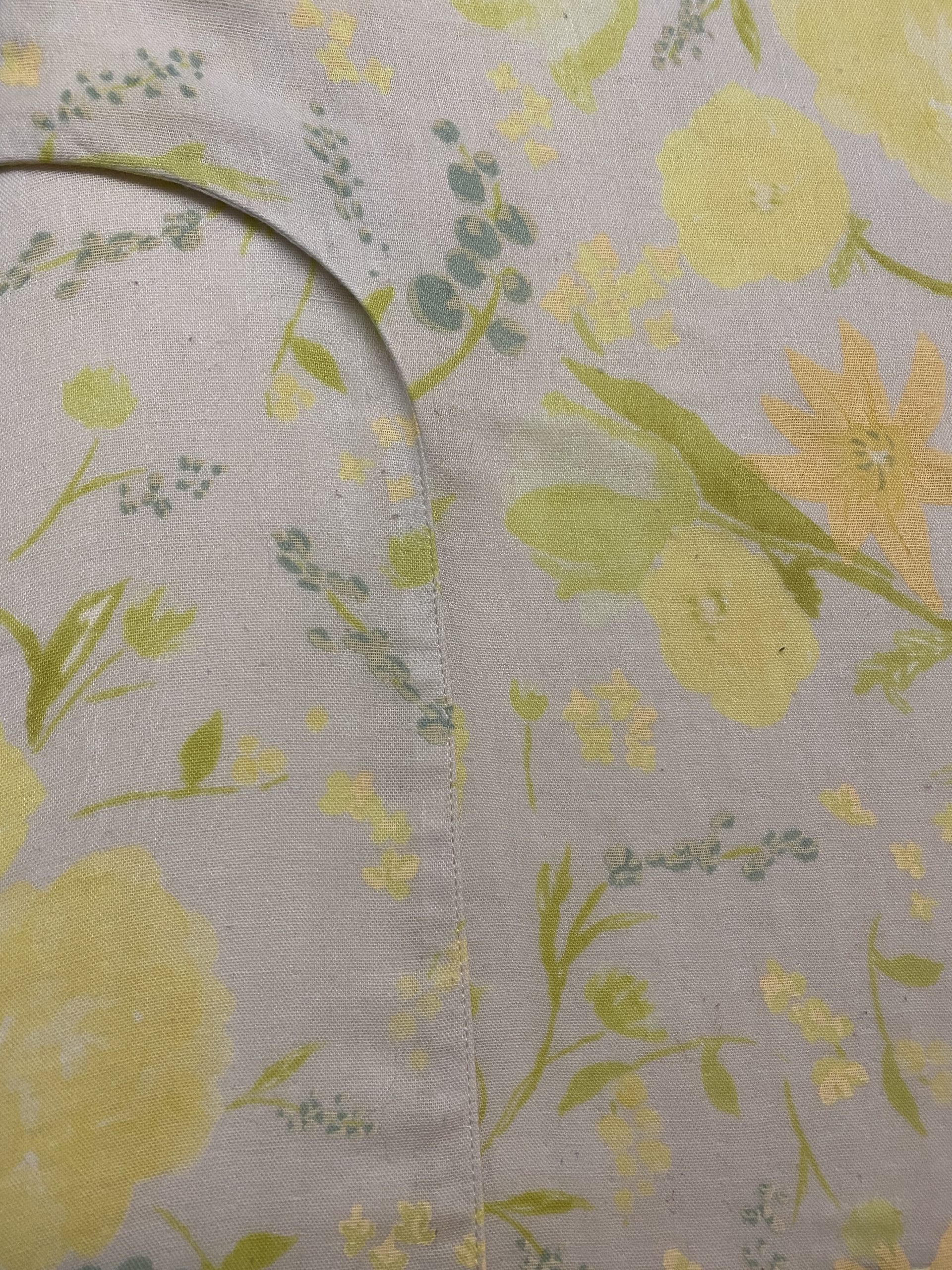
Another nice touch is to edgestitch the seam.  Last summer I asked Philippa Naylor in GMQT (see previous post for additional discussion of GMQT) about how best to handle a side seam with a curved bit under the arm to the extended part for the sleeves.  The top is literally two “T” shaped pieces of fabric with a neck facing and turned up hems (see photo from the back, below). Any curved seam will tend to pull at the curve.  She suggested finishing the seam with an overlock (I used my Janome AirThread2000D serger, but the overcast stitch would do exactly the same), then pressing to the back of the garment and edge stitching.  So I did…worked perfectly (and surprisingly well to me) and kept the curve under the arm from wanting to “wonk” on me.

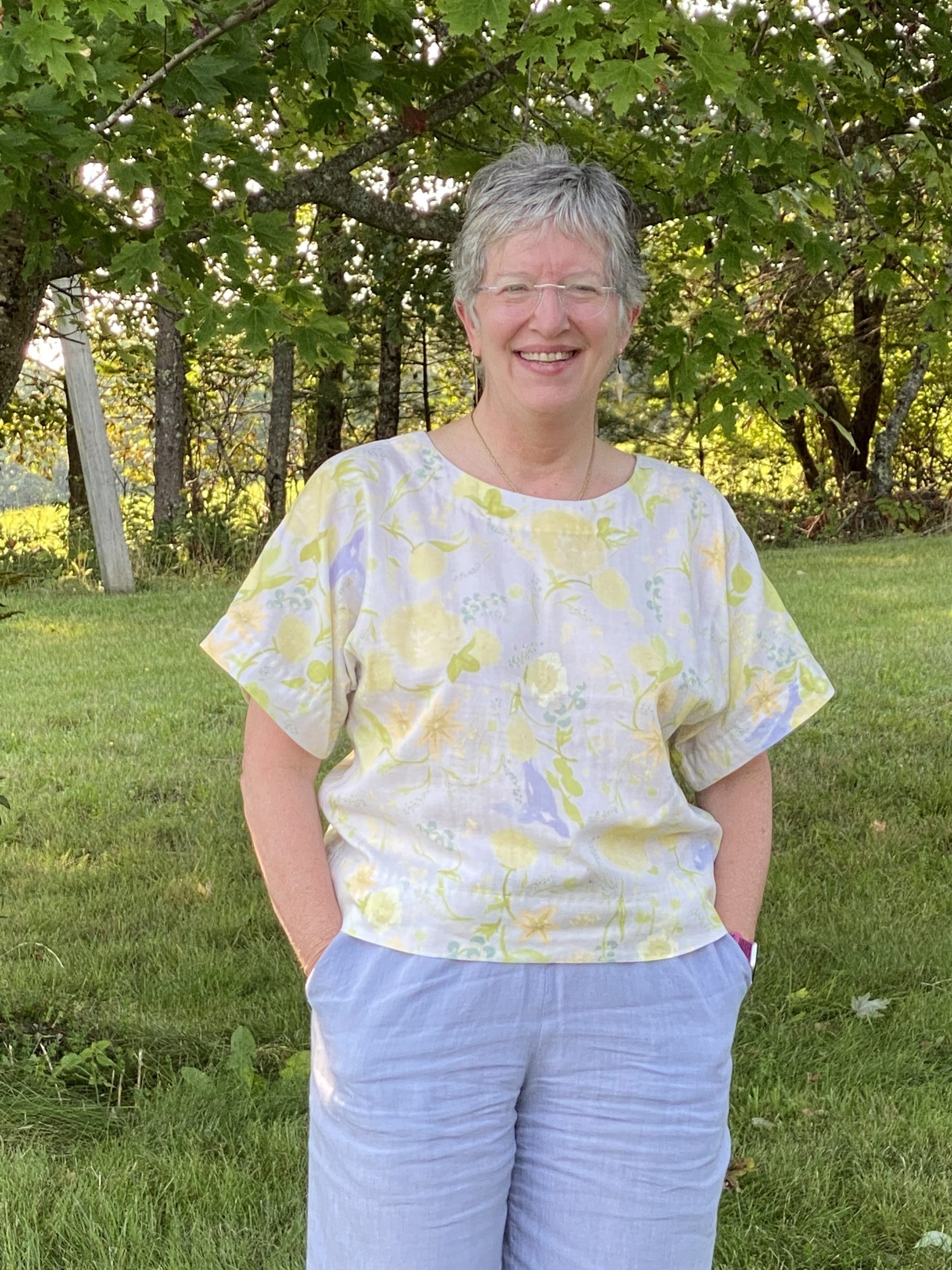
Here’s the finished blouse.

As you can see, this is the simplest of all shapes. The fabric is Nani Iro double gauze, a lightweight cotton that is two layers woven together.

And this is Philippa’s brilliant solution to controlling the tendency of the seam to ripple and buckle at the curve. Worked a charm!  And in case you’re wanting that link to sign up for the Garment Makers Question Time classes with Philippa Naylor, here it is.

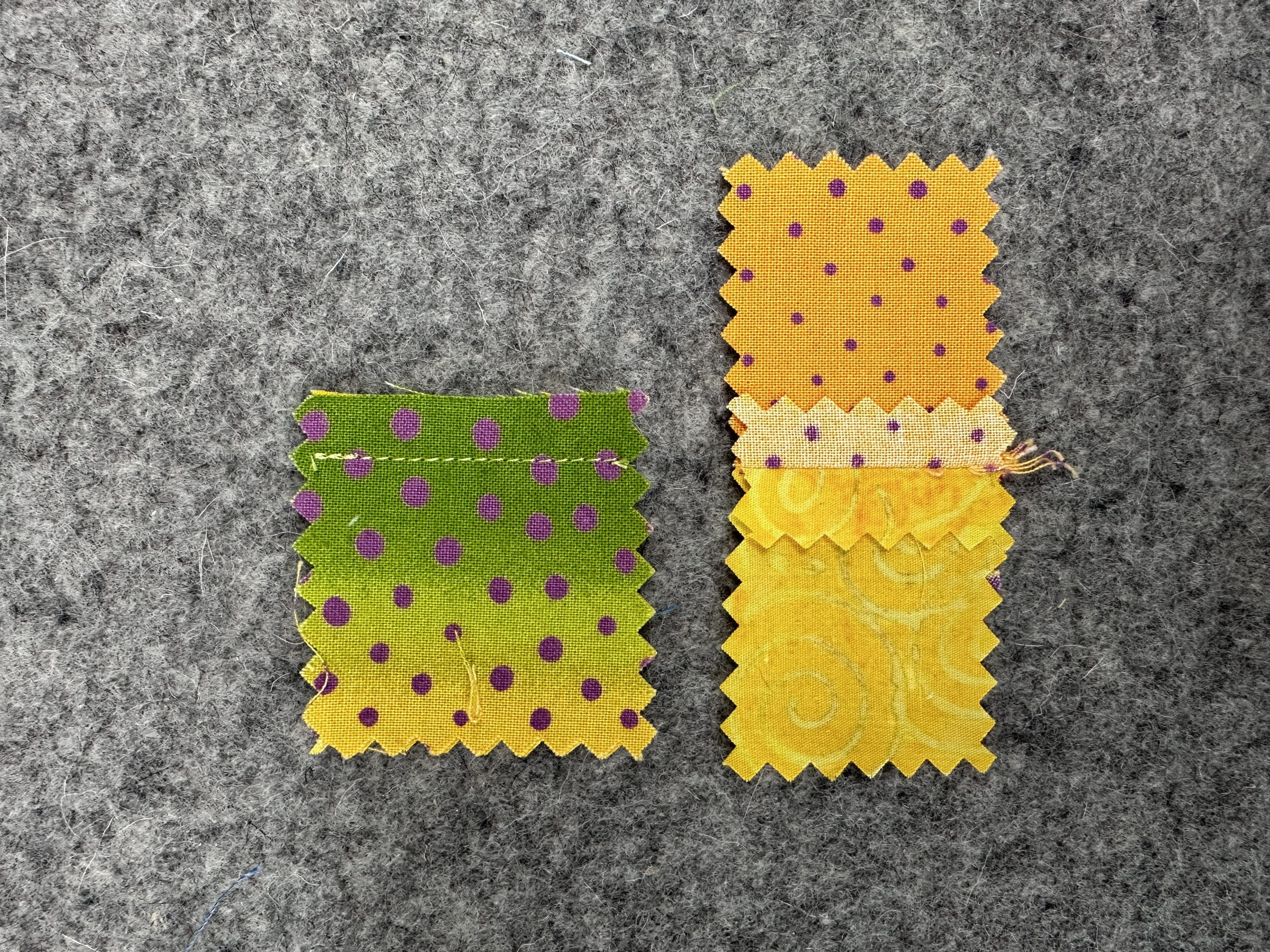
And a tiny PS:  back in the days when dinosaurs walked the earth and my age was in single digits, home ec classes suggested using pinking shears to finish a seam.  It would look like this.  Problem is that with use and washing, it frays.  So here’s a pic, but really, don’t! You put too much effort and money into not doing your best work!
     Left, seam as stitched, and pressed open.  Bleah.  It’s gonna ravel!  Just don’t. See you next time!

Here are the links to all the posts in this series of lessons, techniques that can be applied to virtually any garment and many home dec projects.   Let me know what you’d like to learn and see here on the blog.  Cheers and thanks, Sarah

Lesson 1:   Choosing a Pattern and Starting Tips

Lesson 2:   Making a Muslin, Fitting and Sleeves

Lesson 3:   Matching Plaids, Cutting out Your Garment Pieces

Lesson 4:  Overcast Seams, just like Serged Seams

Lesson 5:   French Seams

Lesson 6:  Lapped and Flat-felled Seams

Lesson 7:  Hong Kong Finish for Seams

Lesson 8:  Lined Patch Pocket Tutorial

Lesson 9:  Hems and Scarf

Anthea Blouse in Sky Blue Linen

Thursday, October 6th, 2022

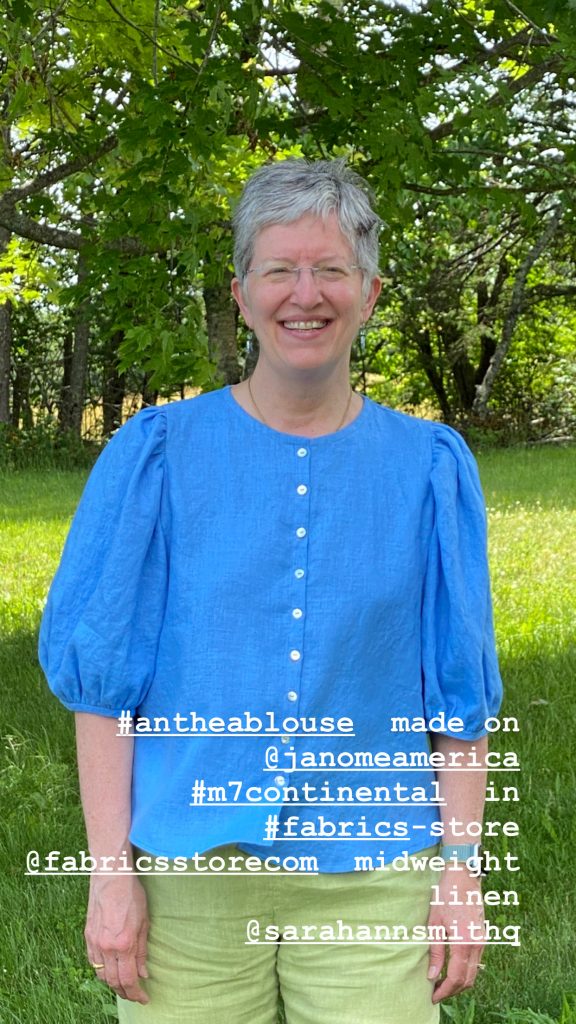
While visiting my favorite local shop, Fiddlehead Artisan Supply, one of the young women working there had on her version of this blouse. Asked the pattern name–Anthea by Anna Allen–went home and ordered it! The colors I’m wearing are Maine Summer and it is so flattering to many body types and comfortable.

Today’s blogpost takes you through making an entire blouse, which presser feet I use on my Janome (I’m a brand ambassador and compensated, but I’d say all this good stuff anyway…they rock!) m7Continental, why and offer tips and tricks for garment construction. Pretty much all Janome machines have or have available these presser feet with the possible exception of the automatic buttonhole, which many but not all of the Janome models have. Comment and let me know what more you’d like to know and what you’d like me to feature on the blog! I’m scaling back travel teaching and hope to have more time for this sort of thing.

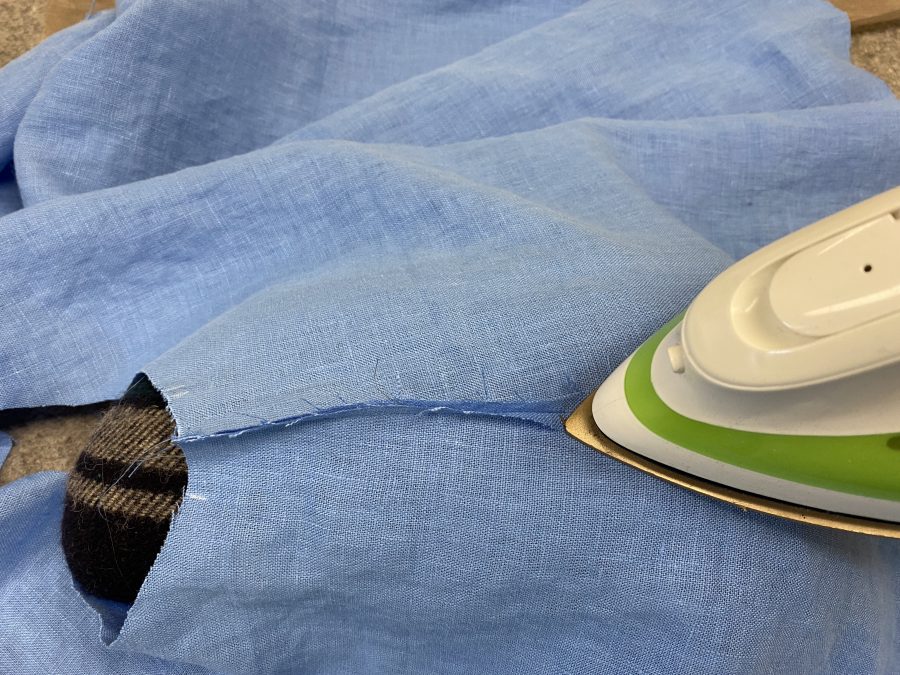
The first thing to do is sew your side and shoulder seams. I opted for French seams for a clean, no-fraying finish. With a 5/8″ seam allowance, I sewed with the WRONG sides together at 3/8.” First press the seam as stitched (flat), then trim to a scant 1/4″ and press the seam allowance open.
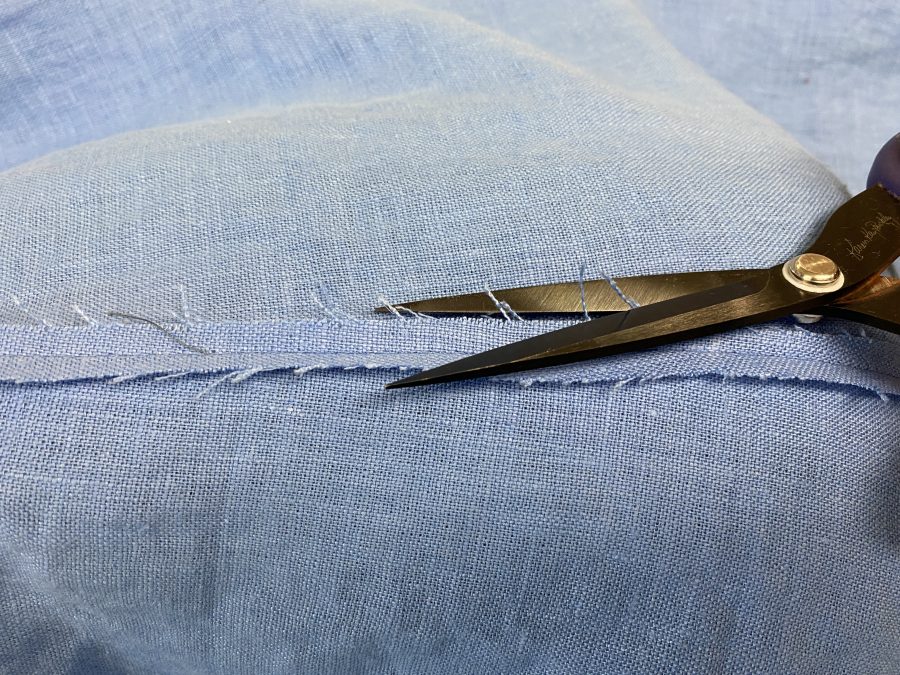
Be sure to trim off the whiskers–you won’t be able to coax them inside the enclosing seam and trimming them later.is a headache.
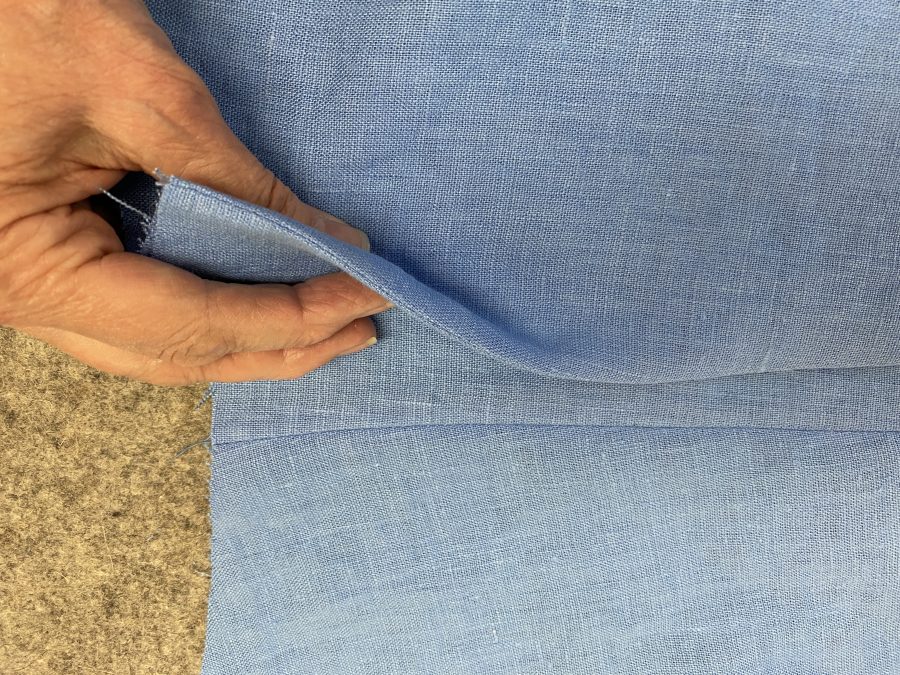
This shows me holding the fabric with right sides together; the fabric is folded EXACTLY on the first line of stitching. You then sew 1/4″ away to enclose all the raw edges.
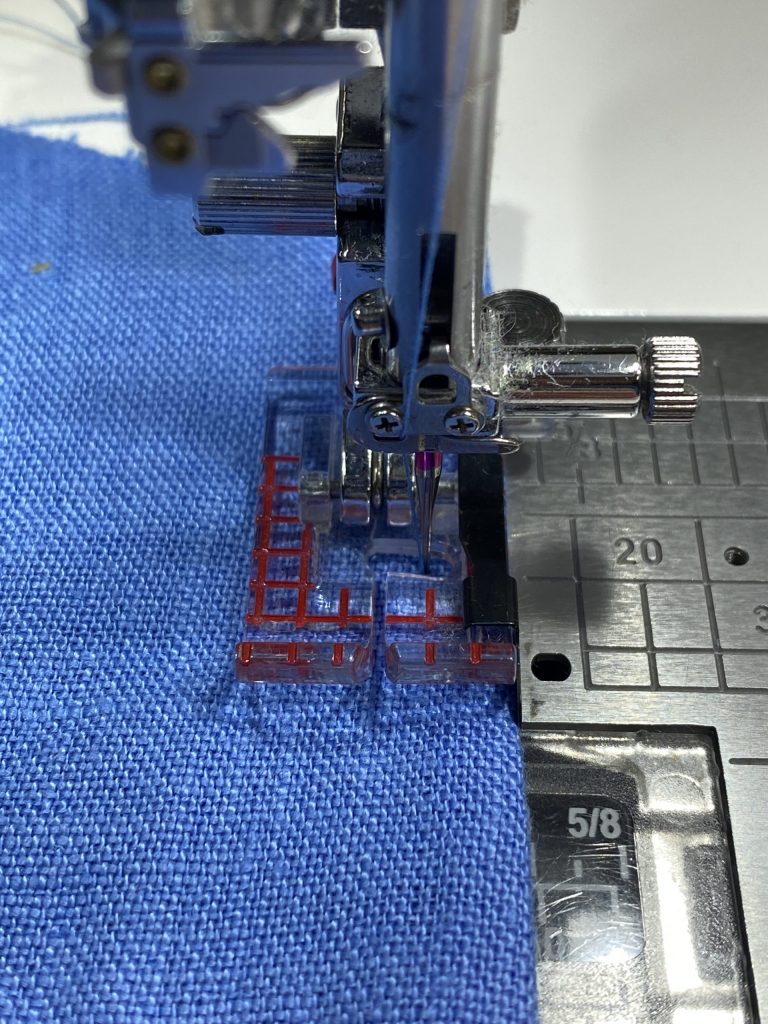
Sew the second part of the French Seam at 1/4″. If you’ve trimmed any stray threads/whiskers, you’ll have a beautiful clean seam. Press to one side (for my blouse I pressed to the back). Notice that the edge of the fabric/seam is on the 3/8″ line but the needle is moved right of center to be at the 1/4″ seamline.
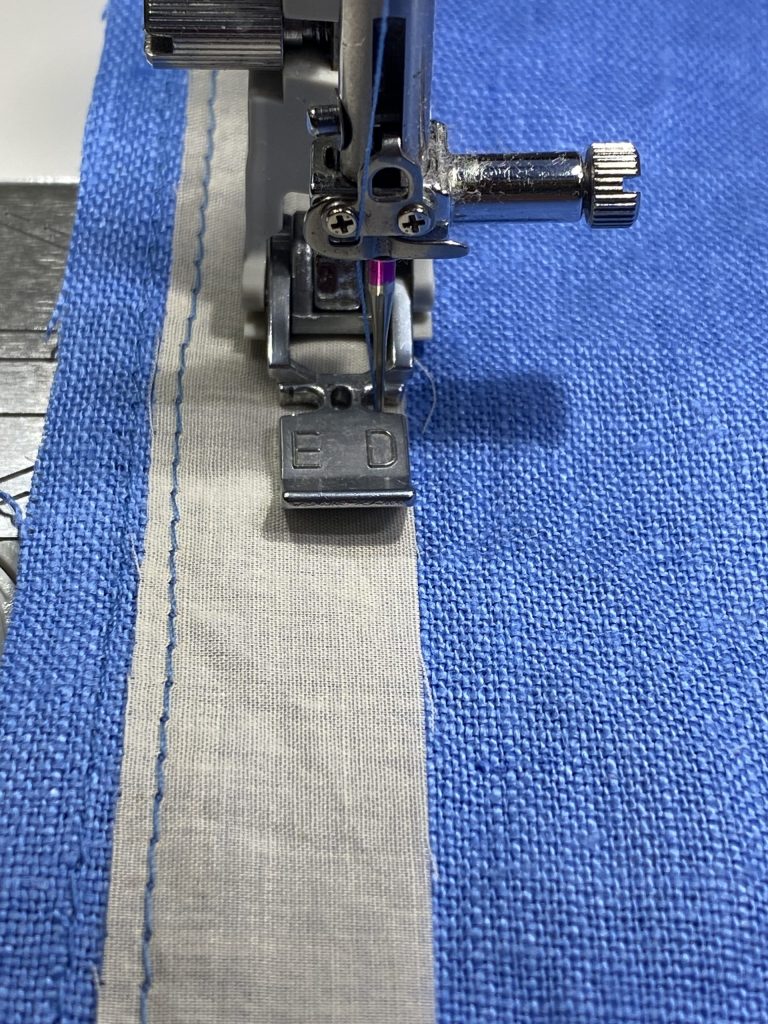
Next, I am stabilizing the button band by using cotton voile (preshrunk) as my interfacing. Unlike the polyesters or fusible we are used to using, it provides strength without bulk and retains a soft, fluid hand to the garment. I sewed the edges in place (so the strip won’t wiggle and wad up during use). The zipper foot is one of my favorite ways to get a perfect, consistent edge: set the side of the foot on the edge of the interfacing and move the needle toward the center. Be sure it won’t hit the foot but also doesn’t ride on the very outer edge of the interfacing and chew it up. ON the left you can see stay stitching.
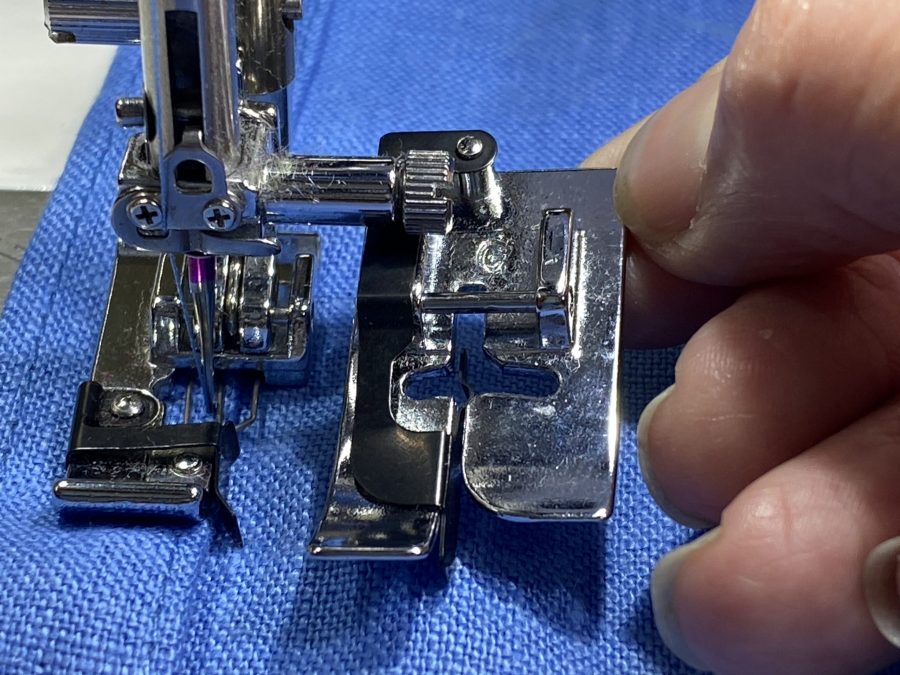
I’ve folded the cut-on button band to the inside and am now stitching it to the front. When I have a “lip” or folded edge and want to edge stitch, I use either the edge stitching foot (on the right, which I think of as the Ice Skate with the metal guide in the center) or the over cast foot (on the left, in use). Using a straight stitch, place the foot so the blade is snug against the fold and move the needle to make a nice, narrow topstitch. Be sure the needle won’t hit the wires in the presser foot by hand-walking the needle for one or two stitches.
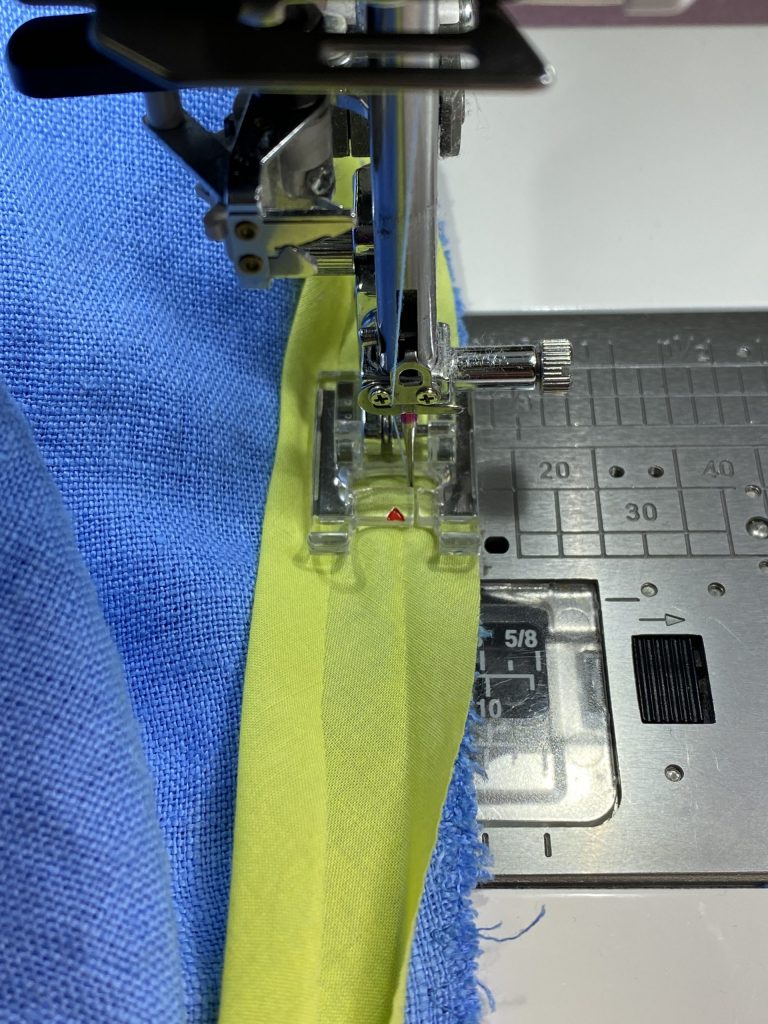
Next up: applying a bias binding to enclose the seam and act as a facing on the neckline. Here I’m using what may be my favorite presser foot, the F2 appliqué foot. The wide open toes and clear visibility help me sew more carefully and precisely. This photo applies to both facing the neckline and covering the edges of the set-in sleeve seam.
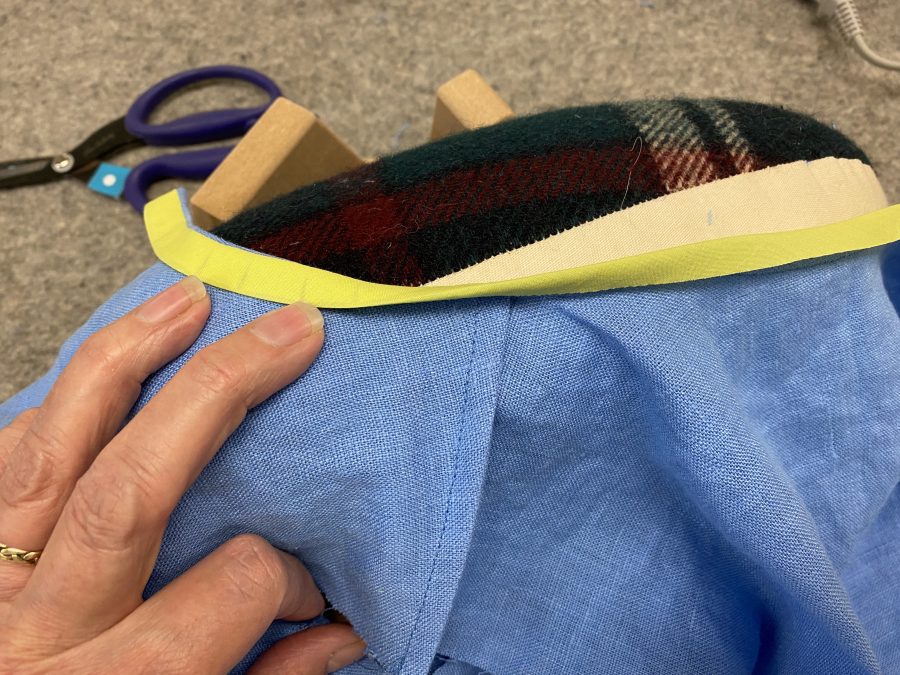
Buying a GOOD quality tailor’s ham and base to hold it has been one of the best, most useful purchases of the year. After 50 years of using my mother’s horrid old ham, I’m ready to sew! Here I’m pressing the bias in place on the neckline. You can see the narrow French seam on the shoulder in the center of the photo. As I press, I am easing the bias so that it lays nice and flat. I used my seam gauge to make sure the depth is even, then edge-stitch all the way around the neck.
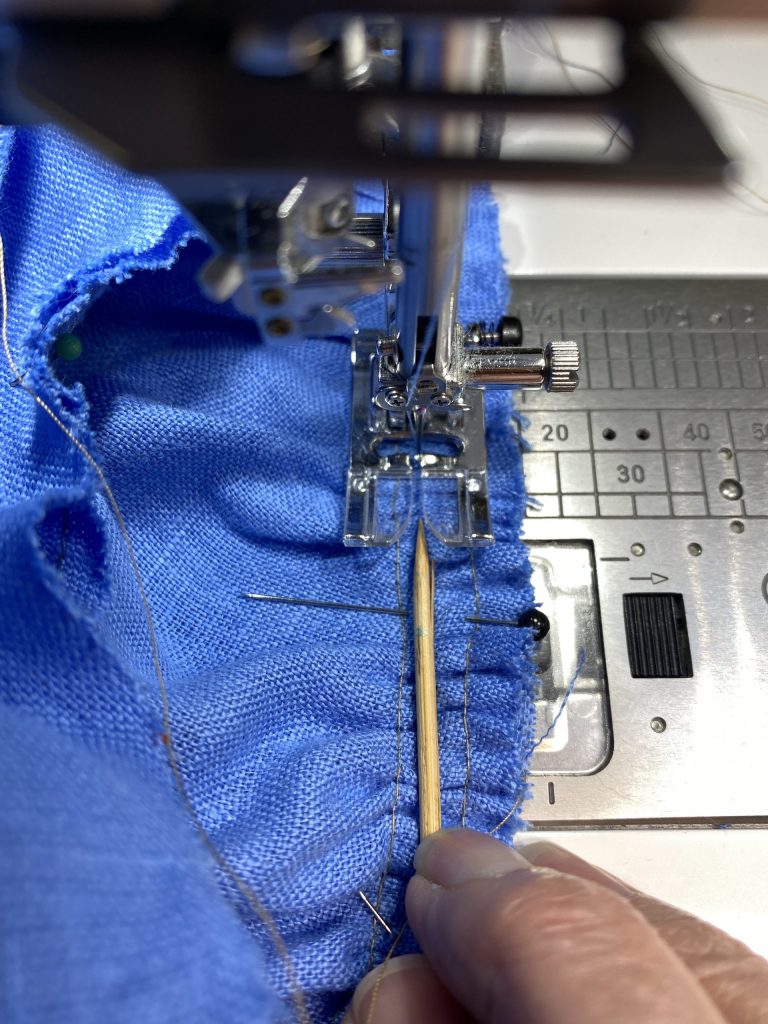
Once the body is complete (except for the hem), it is time to start the sleeves. Although I have sewn garments for almost (GULP) 60 years–yes I started very young–I’ve been taking an outstanding online course with Philippa Naylor, Garment Makers Question Time. The price is phenomenal for the amount of instruction you get each of the 12 months. More projects coming up! Anyway, I learned to set the gathering stitches at 1/2″ and 3/4″ and sew down the middle at 5/8″. Philippa’s way works better: sew your gathering stitches one thread into the seam allowance from the final seam line and 1/4″ closer to the raw edge. Gather, distribute the gathering appropriately, and then sew the seam just barely to the left of the left-side gathering stitch. I like using a thin bamboo skewer to coax and ease the gathers as I stitch. Again, I love that open visibility foot!

Here is a link to Philippa’s Garment Makers Question Time home page. Highly recommended!

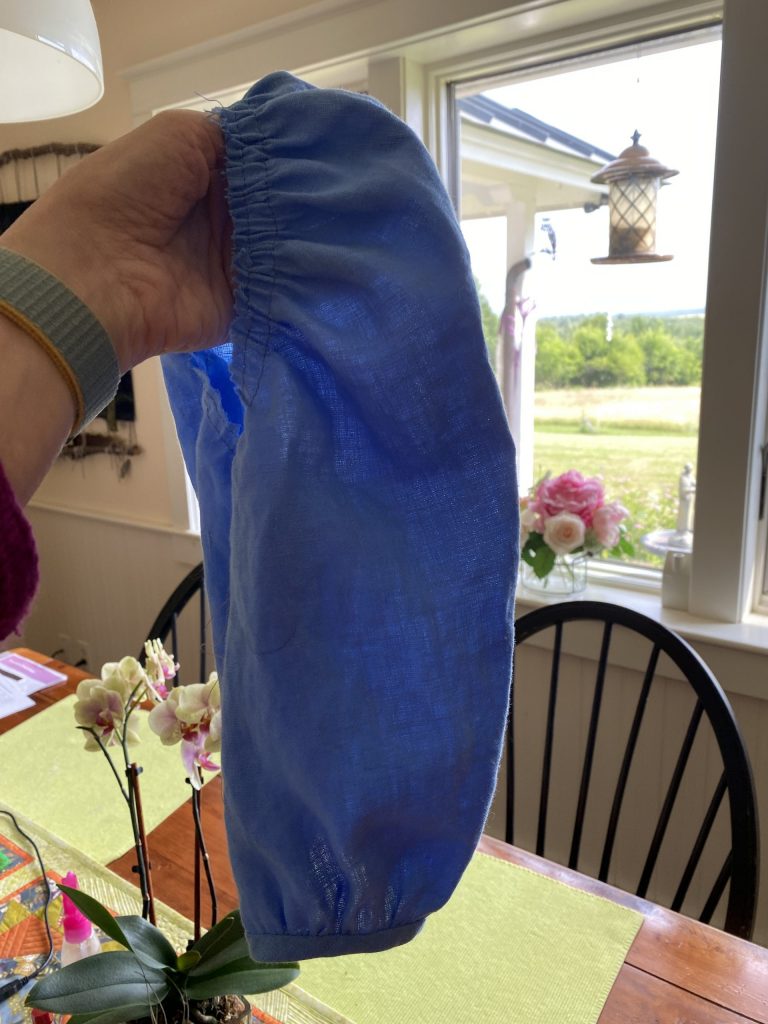
Here is the sleeve with the seam sewn and gathers gathered. I was a tad leery that the shoulders would be too narrow, but I did the right thing and made a toile (practice garment) out of cheap cheap cheap white fabric, and the sleeve seam is indeed set in from the shoulder point–this helps the gathers get that nice rounded puff! For the hem, at the top of the next photo, I sewed a linen bias strip to the right side, turned to the inside, and hand-sewed it into place.
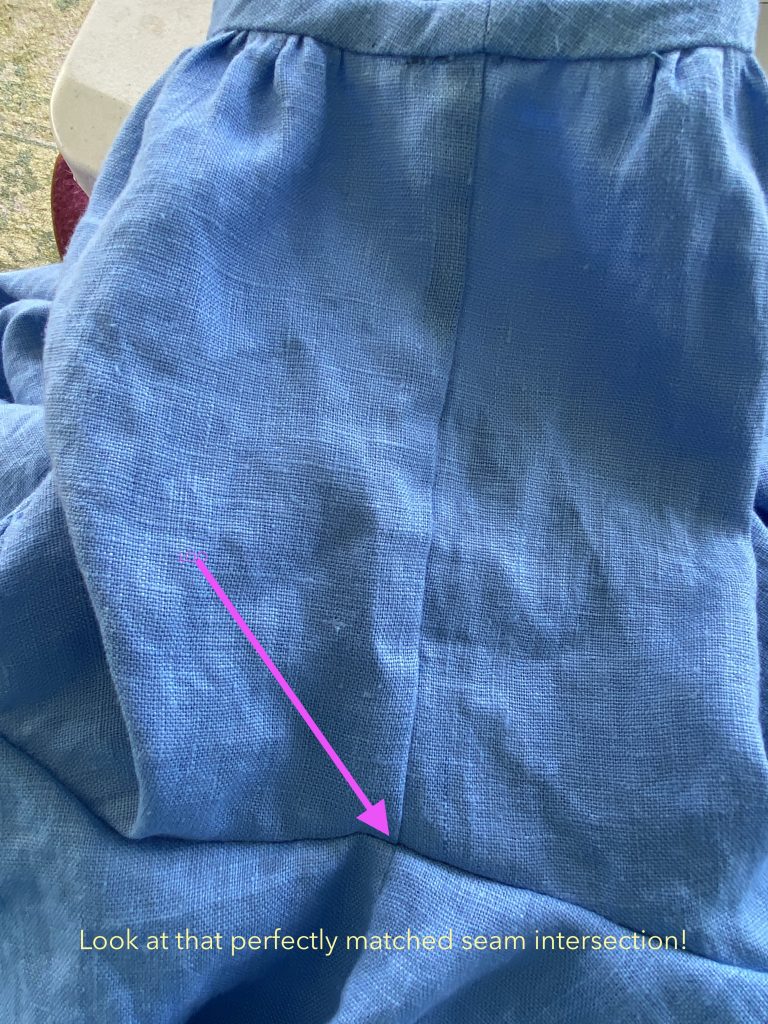
LOOKIT that perfect match! On the first try no less! Once the sleeves are sewn to the bodice, you’ll need to finish the raw edges. The gathers in the sleeves make it too thick for a French Seam, so I chose to use I used a bias edge finish similar to a single-fold bias binding on a quilt. On the neck, the bias was entirely folded to the inside of the garment. Here, you stitch the bias strip of fabric–a lightweight cotton lawn in lime green–to the seam, wrap it around the raw edges, then stitch in the ditch to secure it. I also managed a perfect join on the bias for the “cuff.” Note that the pattern has a wide opening for the bottom of the sleeve–way too wide for the size of my arms. I gathered it up more, making sure it still moved smoothly over/around the elbow, and just made mine narrower.
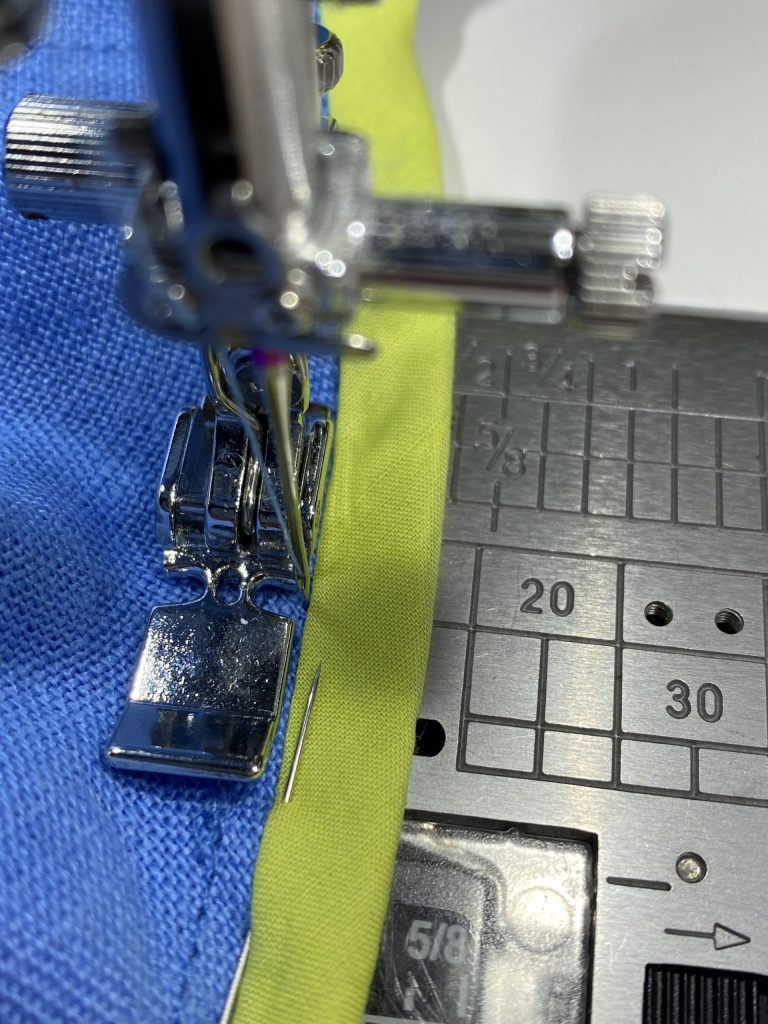
Covering up the raw edges where the sleeve joins the body. Again I’m using the zipper foot. For the way my eyes and brain work, I get the needle closest to the edge of the bias using the zipper foot and moving the needle as far right as it goes. Keep a hawk eye on your stitching because it is all too easy to wander and veer onto the bias.
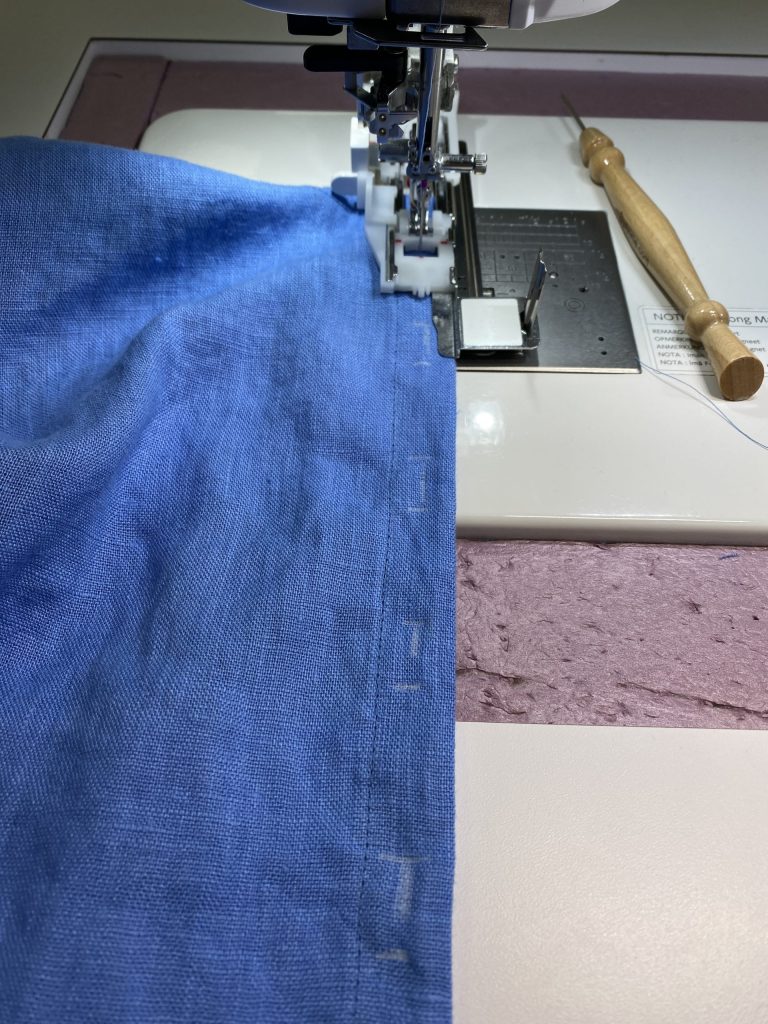
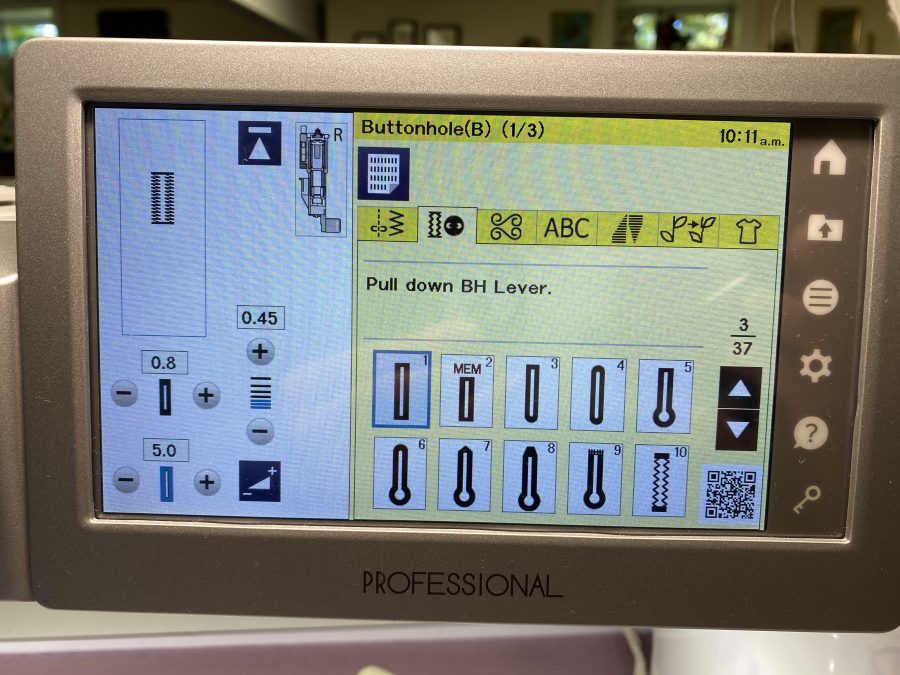
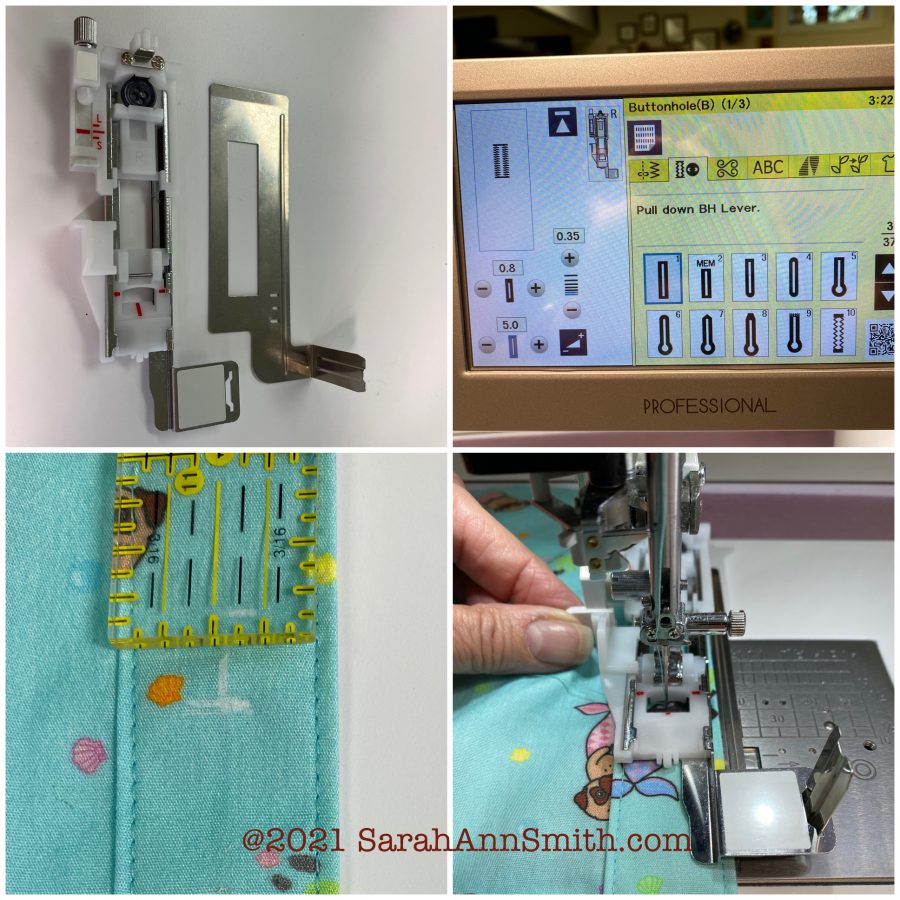
Janome’s automatic buttonhole foot (available on select models including the 9450 and M7) is amazing. You set the button into the back and it picks the perfect size. You can fine tune it if the button is thick or thin. ALWAYS to a test-stitch on a scrap (using the same interfacing and number of layers). You can see I have carefully marked the center of the button holes plus the start and stop lines. The Janome foot has a metal base plate that keeps everything flat and feeding perfectly. Here’s a video of it in action!
You can subscribe to my YouTube channel by clicking on the YouTube link (bottom left) and then following the subscribe button on that site, I don’t post often, but there are some useful videos there. Or just click here to go to my YouTube home page.
This is the setting I used.
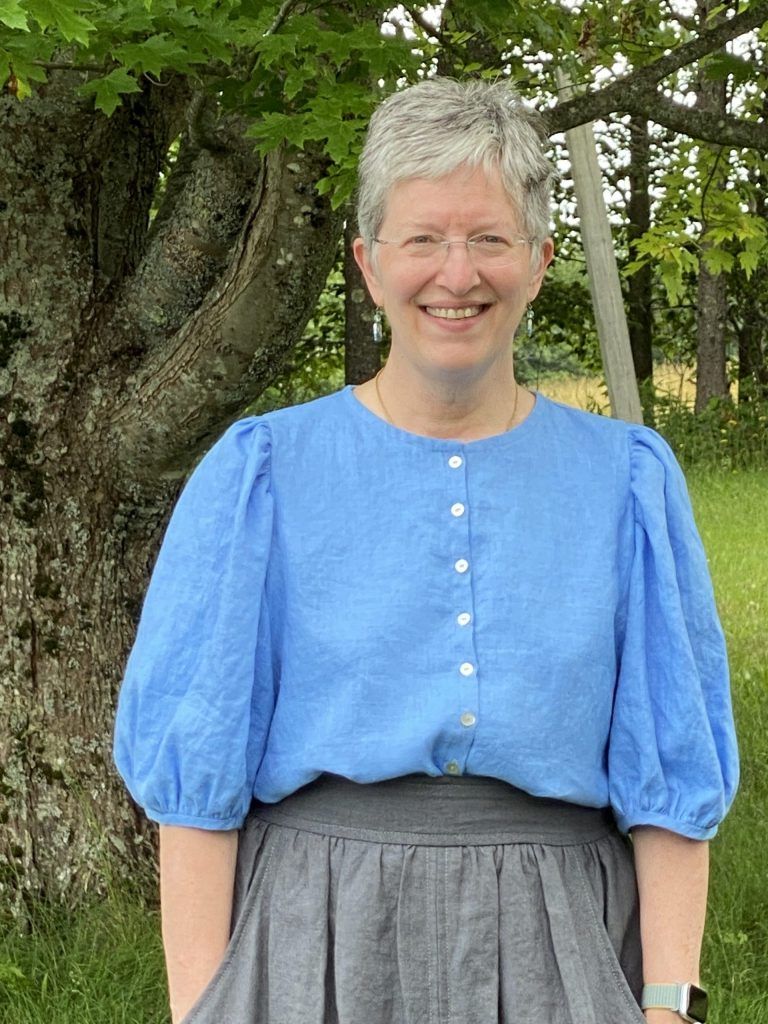
Worn tucked in with a linen skirt in gray. Blouse fabric is the IL-19 5.3 oz linen from Fabrics-store.com. Skirt linen is the Driftwood Linen from Fiddlehead Artisan Supply near me in Belfast, Maine; I bought the Brumby skirt pattern there, too. Yes, they do online / mail order!
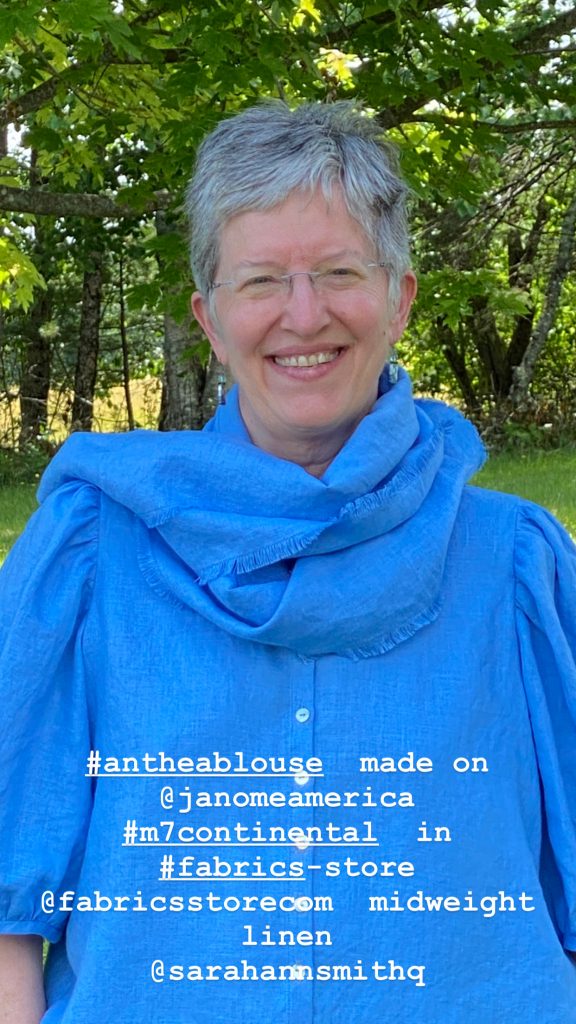
I had some leftover linen, so I made a scarf, too. I sewed a narrow zigzag on all four sides, then carefully frayed the edges. Here’s the link to the pattern again: Anthea by Anna Allen.
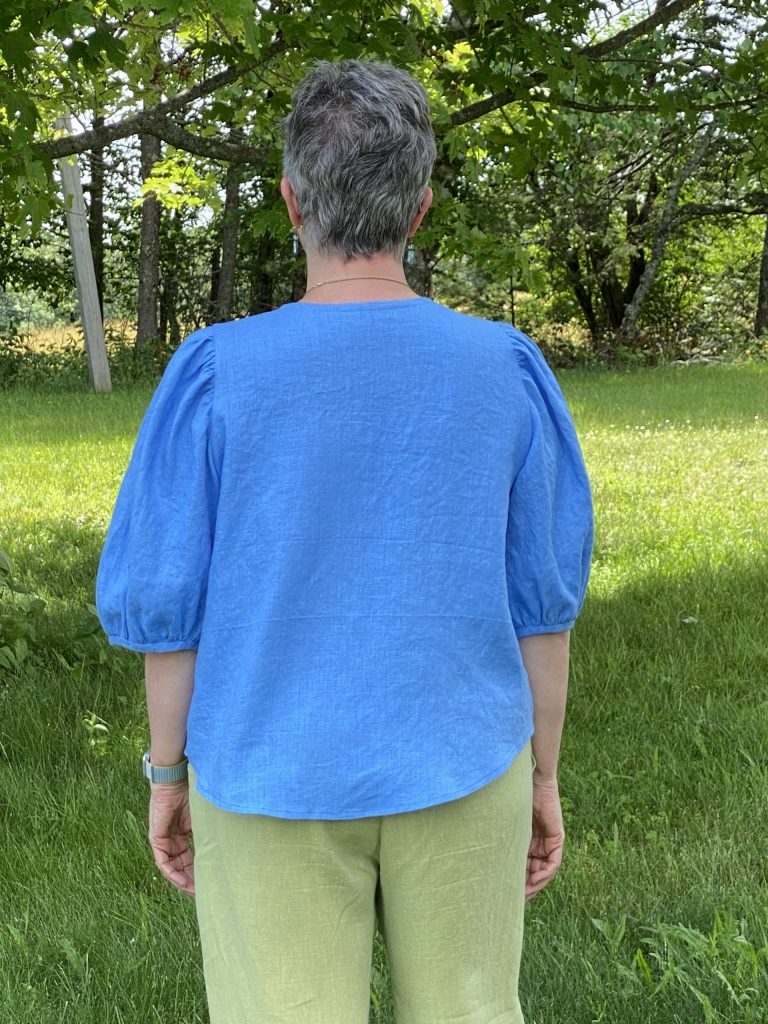
You can also wear the blouse out–it has a narrow 1/2″ hem.
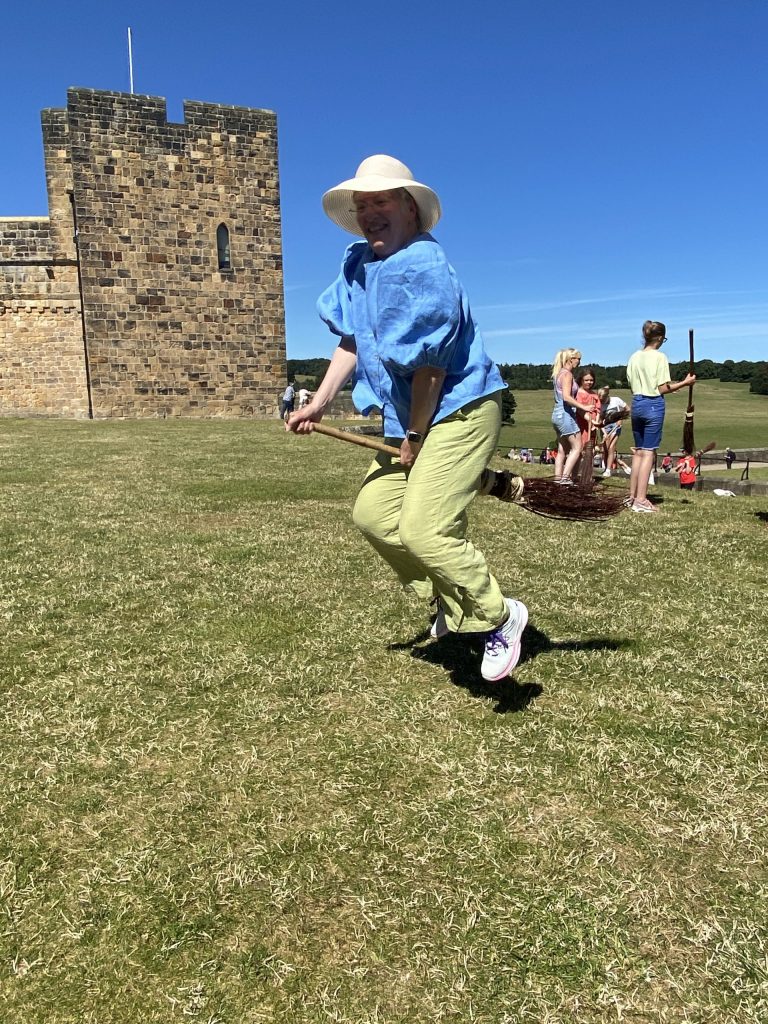
You can even wear it to Broomstick Riding Lessons (at Alnwick Castle this summer)! Funnest photo and time ever!
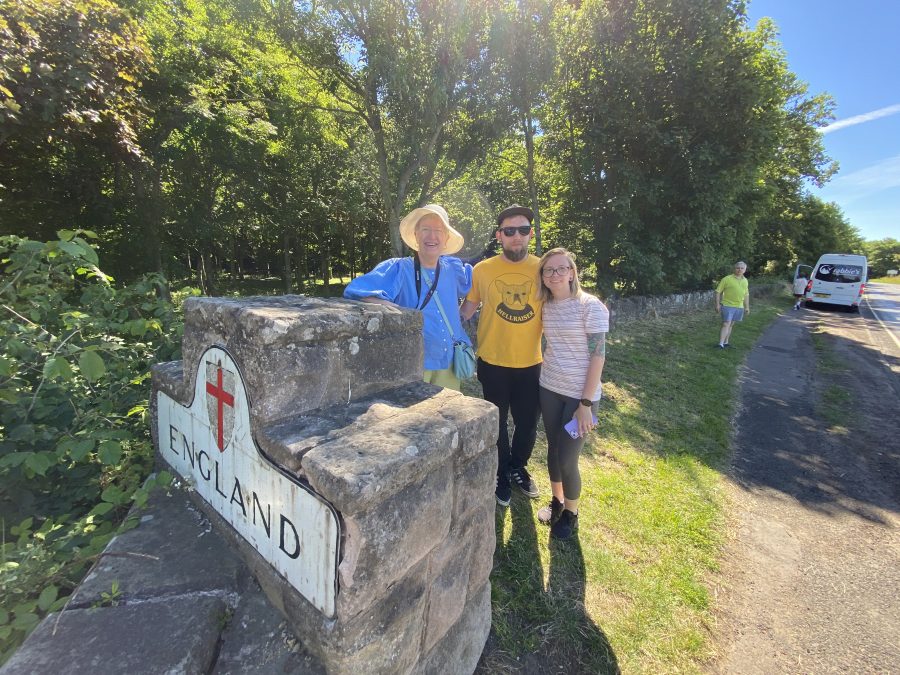
And you can also wear it after you have walked from Scotland to England—all the way across a 100 foot long bridge! With my oldest son and DIL on a trip of a lifetime.

Well I can’t believe it has been half a year since I blogged… that tells you how crazy busy this summer has been. All good stuff, but all at once. I am looking forward to being HOME for three straight months once I return from Houston / International Quilt Festival where I’ll be teaching again. I will try my best to be back before the end of the year…like maybe even in a month?

“Un–boxing” my first designs printed on fabric!

Tuesday, September 21st, 2021

Yes I bit the bullet and had my three collections printed (mostly swatches) at Spoonflower. I’m for the most part delighted with the results, but need to fine-tune color between my monitor and printer and Spoonflower’s printer! I hope you enjoy this video!

I’d love to hear which ones you like best… and if you know anyone at one of my top companies (which I’m still keeping secret LOL!) let me know…and TELL THEM to give me a contract <<<grin>>>.

Mer-Pugs Summer Shirt for Eli

Thursday, July 8th, 2021

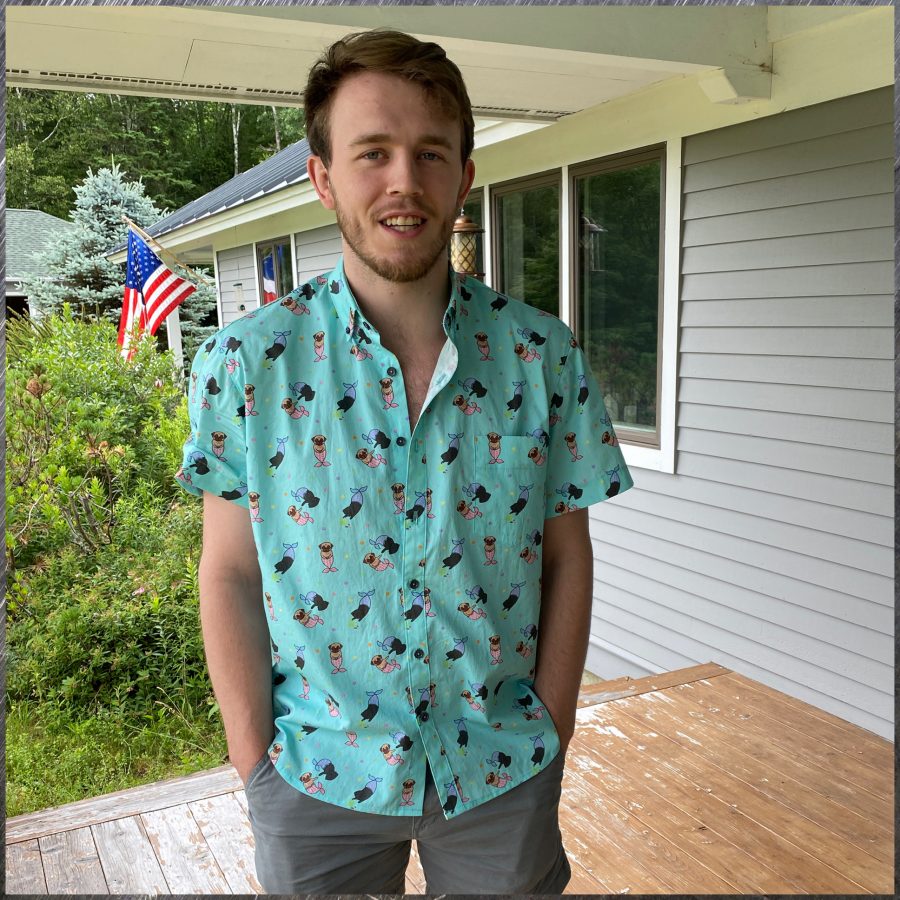
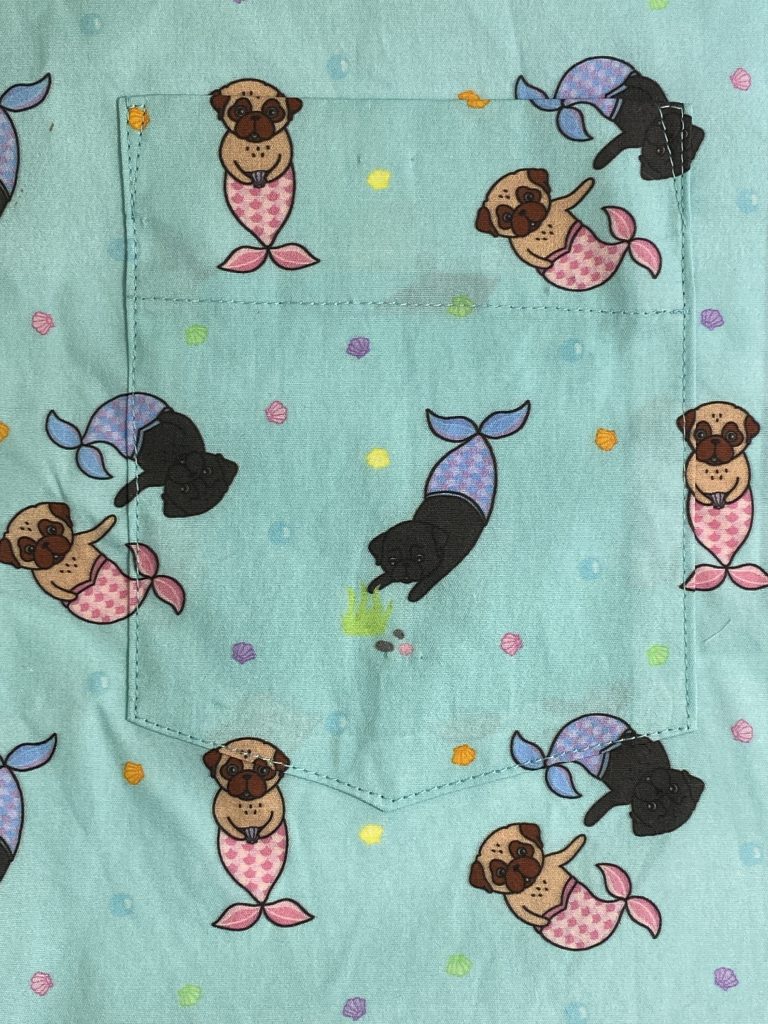
It’s a delightful feeling when your young adult son asks you to make a shirt for him. Since he lives about 5 hours away, going to a fabric store together wasn’t a good option, so I sent him to Spoonflower. LOVE it when his sense of humor prevails: he selected Mer-Pugs! Here’s the link to the fabric; I chose to print on cotton poplin as I’m not fond of their Signature Petal cotton. Needing to order 3 yards, it was a splurge, but it turned out great and he loves it!

Eli’s shirt fits perfectly!

The pattern is Liesl & Co.’s All Day Shirt Pattern. I used this earlier when I made Joshua’s donuts shirt (yes, they both have the same sense of humor!). Since Eli is a bit bigger, I was able to use what I learned making Joshua’s shirt in 2019 (blogpost here). I still had some issues getting the collar to be the size I wanted on the collar stand–I was careful to follow the instructions, but think the collar should be about 1/8″ longer on each side. Eli did not want any pleats on the back but did want short sleeves. He lent me a shirt that fits just the way he wanted so I kept that in the studio to compare as I made the merpugs shirt …much easier to adjust that way!

Earlier this year I showed on Facebook and Instagram how perfectly I was able to align and topstitch the pocket:

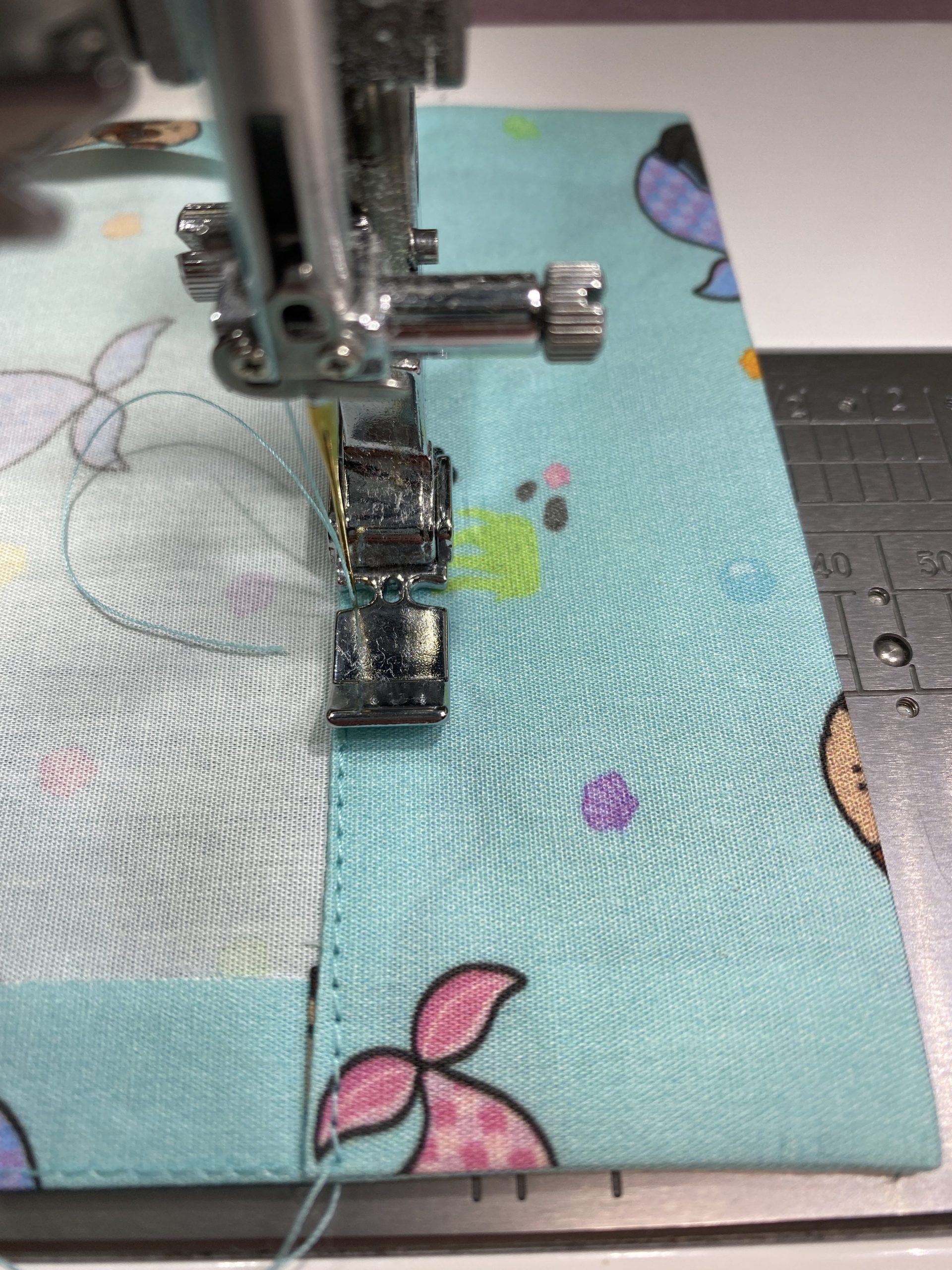
First, prepare the pocket. Turn under seam allowances; pattern instructions have you sew 1/2″ from edge, then iron under concealing the stitching. I did that, but having done perfect edges before without the bother of stitching, I’ll go back to my easier way next time. I love my zipper feet for all sorts of things especially perfect edge stitching. I just get better results than using the edge-stitching foot–try several ways and use what gives YOU your best results. I align the edge of the foot with the fold of the fabric, move the needle in the distance I wish, then keep my left thumbnail on the edge of the fold and foot to keep it straight.
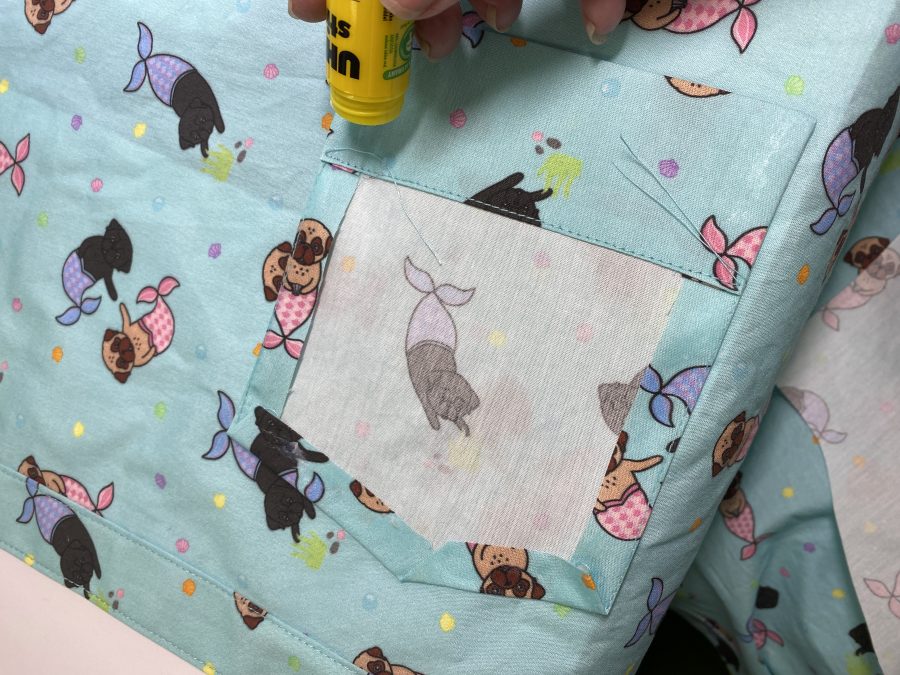
Next tip: GLUE STICK! Be sure to use a WASHASBLE glue stick, not permanent! Run a bit of glue along the sides and bottom.
Glue stick the pocket so you have ABSOLUTELY positively PERFECT alignment. For me, this works better than pins and you get no ripples/distortion from the pins. As with the pocket hem, use the zipper foot, adjust the needle drop to the perfect spot, and sew in place. LOOKIT how those merpugs just swim from the shirt onto the pocket!
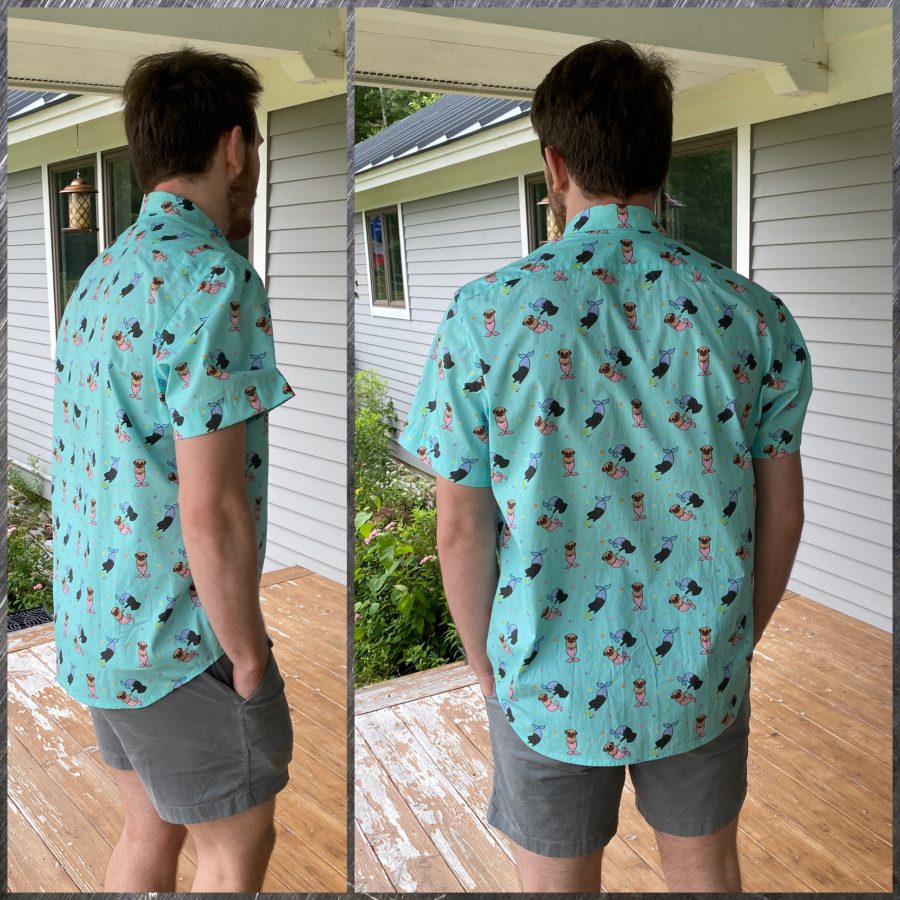
Side and back views. Perfectly aligned the pugs from collar to yoke to shirt back! Having a machine with precision feed like the Janome M7 makes it easy!
My voice sounds funny because I am getting over a cold! Anyway, here’s a quick demo of how FAST it is to do an automatic buttonhole! Next photo shows a side view of the automatic buttonhole foot
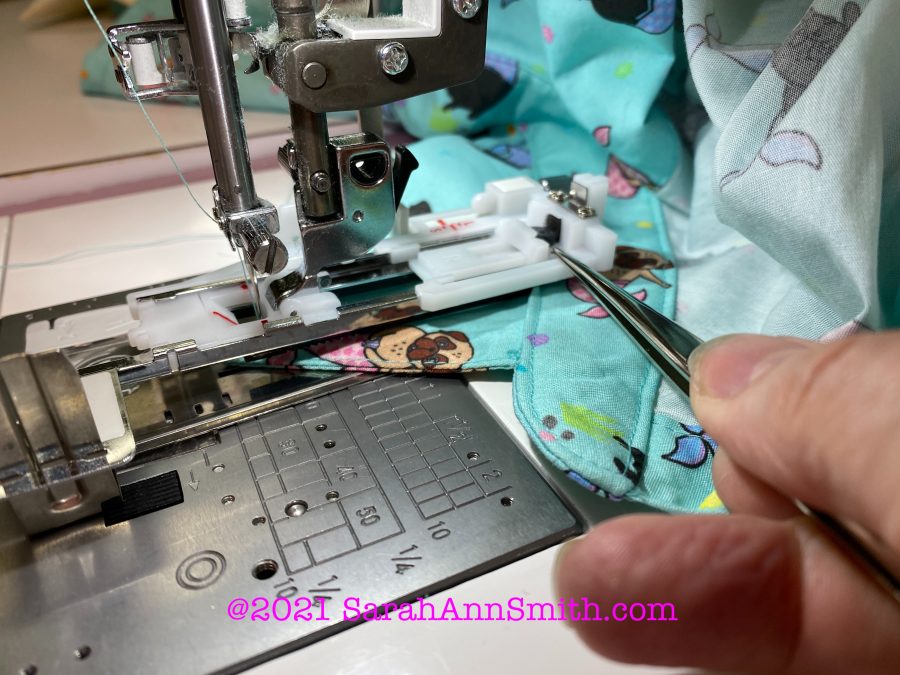
The tip of my awl is pointing to the small button in the back of the automatic buttonhole foot. This is how the foot knows exactly how large to make the buttonhole. It even worked with the teeny tiny buttons (about 3/8″) on the collar!
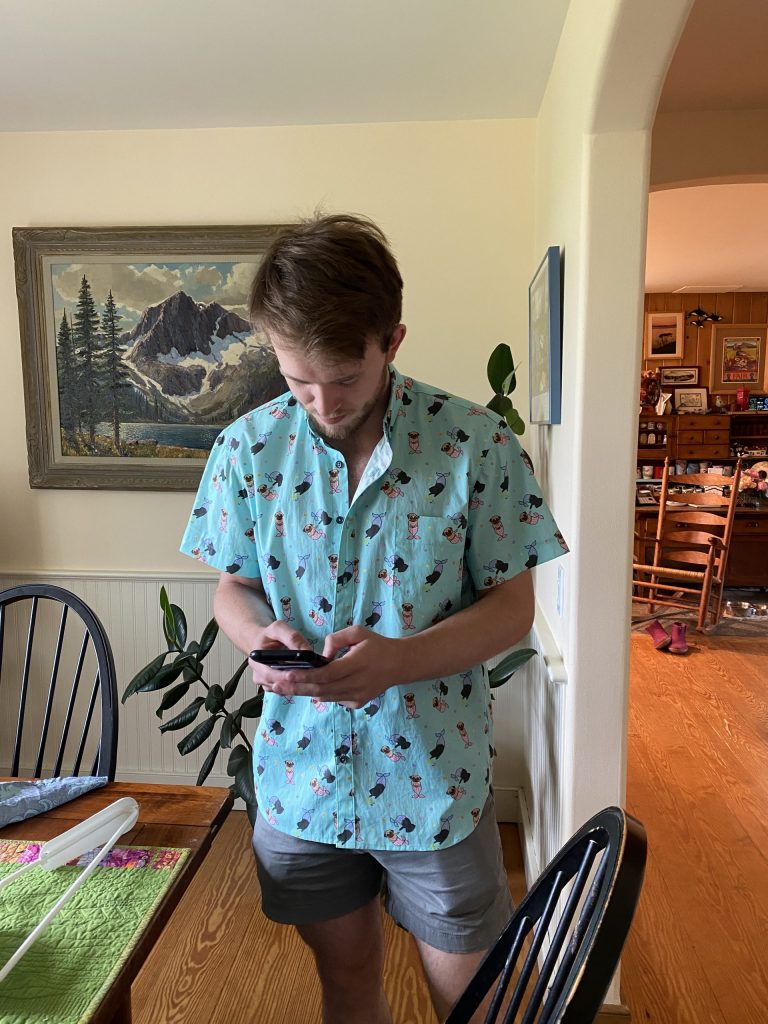
What does a 20-something do as soon as one puts on a new shirt? Check the phone!

Hope you’ve enjoyed this! If you haven’t already, I’d like to invite you to sign up for my monthly (or thereabouts) newsletter! Just look in the right-hand sidebar on this page to sign up, or at the bottom of all the other pages on my blog. Thanks for stopping by!